Groups
Definition
A group is a set together with a binary operation such that:
Closure: The set is closed under the binary operation. For all .
Associativity: The binary operation is associative on the set. For all .
Identity: The set contains an identity element, denoted . For all .
Inverses: All elements in the set have inverse elements in the set, denoted using . For all there exists such that .
This set/operation combination is commonly denoted as the pair .
Referenced by (16 direct, 440 transitive)
Direct references:
Transitive (depth 1):
- cyclic subgroup
- cyclic-subgroup-generated-by-powers
- note-15
- kernel
- alternating group
- Properties of Cosets
- Commutative Ring
- ring-multiplicative-identity
- Ring with Unity
- Cauchy's Integral Theorem
- Simple Poles on the Real Axis
- coset
- Even Integers as a Subgroup
- Left Cosets of
- Properties of Group Homomorphisms
- proof-of-complex-inner-product-space
- rn-vector-space-vs-metric-space
- Scalar
- Vector
Transitive (depth 2):
- lagrange-theorem-for-indices-intuition
- homomorphism-injective-iff-trivial-kernel
- Division Ring
- Multiplicative Inverse
- Hessian Matrix
- note-3
- Parallel
- remark-32
- Vector Multiplication by a Scalar
- Bound vector
- Cross Product
- Direction
- Expected Value
- Free vector
- Gradient
- incompressible
- intuition-13
- invariance-of-curl
- Jacobian Matrix
- Layer
- Left Stochastic Matrix
- Linear Combination
- Neuron
- note-5
- note-9
- Probability Vector
- proof-of-theorem-3
- remark-16
- remark-36
- remark-45
- remark-9
- Stochastic Matrix
- Surface Normal Vector
- theorem-19
- Unit Vector
Transitive (depth 3):
- remark-23
- Directional Derivative
- directional-derivative-is-inner-product-of-vector-and-grad
- Normal Derivative
- proof-of-theorem-19
- remark-30
- remark-46
- Vector Equality
- Zero Vector
- Field
- Entropy
- Entropy Rate
- markov-inequality-fish
- Interpretation
- proof-of-markovs-inequality
- proof-of-weak-asymptotic-equipartition-property
- grad-div-curl-related
- gradient-as-surface-normal-vector
- Laplacian
- Potential Function
- remark-12
- Convex Combination
- Unit
- Doubly stochastic maps increase entropy
- proof-of-probability-vectors-form-a-convex-compact-set
- note-13
- proof-of-gradient-as-surface-normal-vector
- Tangent Vector
Transitive (depth 4):
- doubly-stochastic-maps-increase-entropy-intuition
- note-6
- proof-of-jensens-inequality
- Cross-Entropy
- Gibbs' Inequality
- Chain rule for joint entropy
- joint-entropy-is-less-than-or-equal-to-entropy-of-parts
- KL Divergence
- Noiseless channel transmitting discrete symbols
- note-25
- note-8
- proof-of-concavity-of-entropy
- proof-of-doubly-stochastic-maps-increase-entropy
- proof-of-joint-entropy-is-less-than-or-equal-to-entropy-of-parts
- proof-of-uniform-distribution-maximizes-entropy
- remark-14
- theorem-12
- theorem-16
- Uniform distribution maximizes entropy
- Weak Asymptotic Equipartition Property
- Strong Asymptotic Equipartition Property (Shannon--McMillan--Breiman)
- Examples of Fields
- Matrix
- n-tuple
- Real Numbers
- gravitational-potential-is-a-solution-to-laplaces-equation
- Stoke's Theorem
- Surface Integral over Vector Field
Transitive (depth 5):
- Model Training
- proof-of-nonnegativity-of-conditional-mutual-information
- proof-of-nonnegativity-of-conditional-relative-entropy
- proof-of-nonnegativity-of-mutual-information
- proof-of-nonnegativity-of-relative-entropy
- proof-of-chain-rule-for-entropy
- proof-of-mutual-information-and-entropy
- proof-of-theorem-54
- Doubly Stochastic Matrix
- Markov Chain
- Entry
- arc-length-in-plane
- Ball
- Boundary
- Commensurable
- Complex Numbers
- condensation-point-example
- Convex Function
- Convex Set
- Curl
- del
- Diameter
- Divergence
- euclidean-space-is-metric-space
- every-interval-is-uncountable
- Examples of Rings
- Half-open Interval
- Independent and Identically Distributed
- Inner product
- Interval
- Jensen's Inequality
- k-cell
- Magnitude
- Metric Space
- Probability Density Function
- probability-vectors-form-a-convex-compact-set
- product-of-convex-sets-is-convex
- proof-of-convexity-of-relative-entropy
- proof-of-euclidean-space-is-metric-space
- proof-of-rationals-are-dense-in-reals
- proof-of-reals-are-uncountable
- rational-between-any-two-reals
- Real Sequence
- reals-are-archimedean
- reals-are-uncountable
- Segment
- A sequence in converges iff its components converge
- sup-is-in-closure-of-bounded-nonempty-set-of-reals
- Tangent Space
- concavity-of-entropy-intuition
Transitive (depth 6):
- every-k-cell-is-compact-intuition
- Neighborhood
- note-11
- proof-of-baire-category-theorem-special-case
- proof-of-balls-are-convex
- proof-of-euclidean-spaces-are-complete
- Divergence Theorem of Gauss
- remark-8
- proof-of-theorem-12
- is an inner product space
- Finite Geometric Series
- Fourier Basis
- Generalized Binomial Coefficient
- proof-of-fourier-basis
- remark-5
- Concave Function
- Log is Concave
- Strictly Convex Function
- balls-are-convex
- balls-are-convex-note
- Irrotational
- Divergence Theorem, or, Gauss's Theorem
- Law of Large Numbers
- Perpendicular
- theorem-7-remark
- Cantor set
- Confidence Interval
- existence-and-uniqueness-of-ivp-solutions
- proof-of-cantor-set-is-not-empty
- Second Derivative Test for Convexity
- Uniform Distribution
- proof-of-gibbs-inequality
- proof-of-log-sum-inequality
- proof-of-bolzano-weierstrass
- Ergodic
- Stationary Distribution of an Ergodic Chain
- cantor-bendixson-theorem
- Cauchy Sequence
- Closure
- Compact
- compact-implies-closed
- compact-metric-space-has-countable-base
- compact-metric-spaces-are-complete
- Complete
- Condensation Point
- Connected
- Converge
- diameter-of-set-equals-diameter-of-closure
- discrete-metric-satisfies-axioms
- every-convergent-sequence-in-a-metric-space-is-a-cauchy-sequence
- every-metric-space-where-every-infinite-subset-has-a-limit-point-is-separable
- every-separable-metric-space-has-a-countable-base
- heine-borel-note
- infinite-subset-has-limit-point-implies-compact
- mapping-continuous-iff-inverse-images-of-closed-sets-are-closed
- mapping-continuous-iff-inverse-images-of-open-sets-are-open
- metric-space-context
- nonempty-intersection-of-finitely-many-compact-sets
- Open Cover
- Open Relative
- proof-of-cantor-bendixson-theorem
- proof-of-cauchy-criterion-for-convergence
- proof-of-compact-implies-closed
- proof-of-compact-metric-space-has-countable-base
- proof-of-compact-metric-spaces-are-complete
- proof-of-every-convergent-sequence-in-a-metric-space-is-a-cauchy-sequence
- proof-of-every-separable-metric-space-has-a-countable-base
- proof-of-finite-sets-are-compact
- proof-of-function-is-continuous-at-point-iff-limit-at-point-equals-function-at-point
- Separable
- Separated
- sequence-in-compact-metric-space-has-a-convergent-subsequence
- sequence-theorems-context
- set-and-closure-have-same-limit-points
- set-is-its-closure-iff-it-is-closed
- subsequential-limits-of-a-metric-space-form-a-closed-set
- theorem-50
- theorem-7
- Absolutely Continuous Random Variable
- Convolution
- real-sequence-notation
- proof-of-rational-between-any-two-reals
- cantor-set-contains-no-segment
- proof-of-cantor-set-contains-no-segment
- proof-of-sequence-in-rk-converges-iff-its-components-converge
- proof-of-connected-sets-in-r1-are-intervals
- remark-3
Transitive (depth 7):
- cantor-set-is-compact
- cantor-set-is-perfect
- cantor-set-is-uncountable
- Cauchy criterion for convergence
- euclidean-spaces-are-complete
- limit-of-diameter-of-remaining-points-in-cauchy-sequence-is-zero
- note-49
- proof-of-limit-of-diameter-of-remaining-points-in-cauchy-sequence-is-zero
- proof-of-theorem-50
- closure-distributes-over-finite-unions
- proof-of-non-empty-perfect-sets-in-rk-are-uncountable
- closed-subsets-of-compact-sets-are-compact
- compact-relative-to-subspace
- every-k-cell-is-compact
- finite-sets-are-compact
- Heine-Borel
- infinite-subset-of-compact-set-has-limit-point
- intersection-of-closed-and-compact-is-compact
- intersection-of-nonempty-nested-compact-sets-is-nonempty
- nested-sequence-of-compact-sets-with-lim-diam-zero-has-singleton-intersection
- proof-of-cantor-set-is-compact
- proof-of-closed-subsets-of-compact-sets-are-compact
- proof-of-compact-relative-to-subspace
- proof-of-every-k-cell-is-compact
- proof-of-infinite-subset-has-limit-point-implies-compact
- proof-of-infinite-subset-of-compact-set-has-limit-point
- proof-of-intersection-of-closed-and-compact-is-compact
- proof-of-nonempty-intersection-of-finitely-many-compact-sets
- example-52
- Concavity of Entropy
- proof-of-log-is-concave
- Confidence Interval for a Mean, Known Variance
- Confidence Interval for a Mean, Unknown Variance
- Large-Sample Confidence Interval for a Proportion
- connected-sets-in-r1-are-intervals
- Domain
- proof-of-open-set-in-r1-is-countable-union-of-disjoint-segments
- Diverge
- note-31
- proof-of-condensation-points-of-an-uncountable-subset-of-rk-are-perfect
- proof-of-mapping-continuous-iff-inverse-images-of-closed-sets-are-closed
- Analytic at a point
- analytic-implies-cr-equations
- every-neighborhood-is-an-open-set
- example-4
- Interior Point
- Limit Point
- Manifold
- neighborhood-of-limit-point-contains-infinitely-many-points
- open-closed-intuition
- Point Singularity
- proof-of-cantor-set-is-perfect
- proof-of-closure-distributes-over-finite-unions
- proof-of-every-neighborhood-is-an-open-set
- proof-of-heine-borel
- proof-of-limit-points-form-closed-set
- proof-of-mapping-continuous-iff-inverse-images-of-open-sets-are-open
- proof-of-neighborhood-of-limit-point-contains-infinitely-many-points
- proof-of-open-iff-complement-closed
- proof-of-open-relative-iff-intersection-with-open-subset
- proof-of-sequence-converges-iff-neighborhood-contains-all-but-finitely-many-points
- proof-of-set-is-its-closure-iff-it-is-closed
- proof-of-sup-is-in-closure-of-bounded-nonempty-set-of-reals
- proof-of-union-and-intersection-of-open-and-closed-sets
- sequence-converges-iff-neighborhood-contains-all-but-finitely-many-points
- Singularity
- proof-of-intersection-of-nonempty-nested-compact-sets-is-nonempty
- open-relative-iff-intersection-with-open-subset
- Surface Normal
- euclidean-space-is-separable
- proof-of-every-metric-space-where-every-infinite-subset-has-a-limit-point-is-separable
- proof-of-set-and-closure-have-same-limit-points
Transitive (depth 8):
- theorem-1
- Cauchy Integral Theorem
- closed-path-of-path-independent-integral-is-zero
- Contour Integral
- Green's Theorem
- Path Independent
- Random Variable
- Taylor Expansion Theorem
- Volume Integral
- proof-of-weierstrass
- proof-of-sequence-in-compact-metric-space-has-a-convergent-subsequence
- Open
- proof-of-nested-sequence-of-compact-sets-with-lim-diam-zero-has-singleton-intersection
- Closed
- Dense
- function-is-continuous-at-point-iff-limit-at-point-equals-function-at-point
- Isolated Point
- Limit
- limit-of-a-function-characterized-by-limits-of-sequences
- limit-point-implies-convergent-sequence
- Perfect Set
- proof-of-countable-closed-set-has-isolated-points
- proof-of-limit-point-implies-convergent-sequence
- proof-of-set-and-its-limit-points-may-have-different-limit-points
- proof-of-subsequential-limits-of-a-metric-space-form-a-closed-set
- Weierstrass
- proof-of-convergent-sequences-are-bounded
- proof-of-limits-of-sequences-are-unique
- example-6
- Radius of Convergence and Nearest Singularity
- Removable Singularity
- theorem-9
Transitive (depth 9):
- Special case of Blaire's theorem
- countable-closed-set-has-isolated-points
- Limit cycle
- limit-points-form-closed-set
- open-iff-complement-closed
- poincare-bendixson
- union-and-intersection-of-open-and-closed-sets
- proof-of-cauchys-integral-theorem
- proof-of-integral-of-one-over-z-around-unit-circle
- rationals-are-dense-in-reals
- Cauchy Principal Value
- Complex Derivative
- Complex Differentiable
- limit-of-a-function-at-a-point-is-unique-if-it-exists
- Partial Derivative
- remark-7
- proof-of-limit-of-a-function-at-a-point-is-unique-if-it-exists
- proof-of-theorem-7
- Analytic
- Base
- Cauchy-Riemann Equations
- Component Function
- Conserved Quantity
- Continuously Differentiable
- Differentiable
- open-set-in-r1-is-countable-union-of-disjoint-segments
- Total derivatives are unique
- theorem-7-intuition
- non-empty-perfect-sets-in-rk-are-uncountable
- A/B Test
- Binomial Distribution
- chebyshev-fish
- Chebyshev's Inequality
- chebyshevs-inequality-note
- Cumulative Distribution Function
- Discrete Random Variable
- Markov's Inequality
- Moment Generating Function
- Negative Binomial Distribution
- Normal Approximation to the Binomial
- Normal Distribution
- Poisson Approximation to the Binomial
- Poisson Distribution
- Probability Distribution
- proof-of-chebyshevs-inequality
- Self-Information
- Standard Normal Distribution
- State Space
- Variance
- example-8
Transitive (depth 10):
- Cauchy-Goursat Theorem
- Entire
- Residue Theorem
- theorem-1-intuition
- theorem-6
- Hypergeometric Distribution
- proof-of-law-of-large-numbers
- Derivative Function
- proof-of-analytic-implies-cr-equations
- Vector Function
- Conservative system
- Gradient System
- Identically Distributed
- Mutual Independence
- Pairwise Independence
- Level Surface
- Mean Value Theorem
- Total Derivative
- Geometric Distribution
- Stable limit cycle
- Unstable limit cycle
- Moment Generating Function of a Sum
- Sum of Independent Normal Random Variables
- Sum of Independent Poisson Random Variables
- Conditional Probability Distribution
- Product Distribution
- proof-of-euclidean-space-is-separable
- Standard Deviation
- variance-interpretation
Transitive (depth 11):
- proof-of-joint-is-marginal-times-conditional
- proof-of-conservative-systems-have-no-attracting-fixed-points
- Tangent Plane
- Multiplication Rule for Distributions
- Mutual Information
- Central Limit Theorem
- Line Integral of Vector Function
- Vector Field
Transitive (depth 12):
Examples
Some examples of groups:
- The integers under addition: . The identity element is .
- The non-zero reals under multiplication: . The identity element is .
- invertible matrices.
A non-example is the naturals under addition - . The naturals are closed under addition, but there is no identity element since isn't included, and thus no inverses either.
Abelian Groups
Abelian groups are groups whose operation is commutative. For .
Referenced by (5 direct, 428 transitive)
Direct references:
Transitive (depth 1):
- Commutative Ring
- ring-multiplicative-identity
- Ring with Unity
- proof-of-complex-inner-product-space
- rn-vector-space-vs-metric-space
- Scalar
- Vector
Transitive (depth 2):
- Division Ring
- Multiplicative Inverse
- Hessian Matrix
- note-3
- Parallel
- remark-32
- Vector Multiplication by a Scalar
- Bound vector
- Cross Product
- Direction
- Expected Value
- Free vector
- Gradient
- incompressible
- intuition-13
- invariance-of-curl
- Jacobian Matrix
- Layer
- Left Stochastic Matrix
- Linear Combination
- Neuron
- note-5
- note-9
- Probability Vector
- proof-of-theorem-3
- remark-16
- remark-36
- remark-45
- remark-9
- Stochastic Matrix
- Surface Normal Vector
- theorem-19
- Unit Vector
Transitive (depth 3):
- remark-23
- Directional Derivative
- directional-derivative-is-inner-product-of-vector-and-grad
- Normal Derivative
- proof-of-theorem-19
- remark-30
- remark-46
- Vector Equality
- Zero Vector
- Field
- Entropy
- Entropy Rate
- markov-inequality-fish
- Interpretation
- proof-of-markovs-inequality
- proof-of-weak-asymptotic-equipartition-property
- grad-div-curl-related
- gradient-as-surface-normal-vector
- Laplacian
- Potential Function
- remark-12
- Convex Combination
- Unit
- Doubly stochastic maps increase entropy
- proof-of-probability-vectors-form-a-convex-compact-set
- note-13
- proof-of-gradient-as-surface-normal-vector
- Tangent Vector
Transitive (depth 4):
- doubly-stochastic-maps-increase-entropy-intuition
- note-15
- note-6
- proof-of-jensens-inequality
- Cross-Entropy
- Gibbs' Inequality
- Chain rule for joint entropy
- joint-entropy-is-less-than-or-equal-to-entropy-of-parts
- KL Divergence
- Noiseless channel transmitting discrete symbols
- note-25
- note-8
- proof-of-concavity-of-entropy
- proof-of-doubly-stochastic-maps-increase-entropy
- proof-of-joint-entropy-is-less-than-or-equal-to-entropy-of-parts
- proof-of-uniform-distribution-maximizes-entropy
- remark-14
- theorem-12
- theorem-16
- Uniform distribution maximizes entropy
- Weak Asymptotic Equipartition Property
- Strong Asymptotic Equipartition Property (Shannon--McMillan--Breiman)
- Examples of Fields
- Matrix
- n-tuple
- Real Numbers
- gravitational-potential-is-a-solution-to-laplaces-equation
- Stoke's Theorem
- Surface Integral over Vector Field
Transitive (depth 5):
- Model Training
- proof-of-nonnegativity-of-conditional-mutual-information
- proof-of-nonnegativity-of-conditional-relative-entropy
- proof-of-nonnegativity-of-mutual-information
- proof-of-nonnegativity-of-relative-entropy
- proof-of-chain-rule-for-entropy
- proof-of-mutual-information-and-entropy
- proof-of-theorem-54
- Doubly Stochastic Matrix
- Markov Chain
- Entry
- arc-length-in-plane
- Ball
- Boundary
- Commensurable
- Complex Numbers
- condensation-point-example
- Convex Function
- Convex Set
- Curl
- del
- Diameter
- Divergence
- euclidean-space-is-metric-space
- every-interval-is-uncountable
- Examples of Rings
- Half-open Interval
- Independent and Identically Distributed
- Inner product
- Interval
- Jensen's Inequality
- k-cell
- Magnitude
- Metric Space
- Probability Density Function
- probability-vectors-form-a-convex-compact-set
- product-of-convex-sets-is-convex
- proof-of-convexity-of-relative-entropy
- proof-of-euclidean-space-is-metric-space
- proof-of-rationals-are-dense-in-reals
- proof-of-reals-are-uncountable
- rational-between-any-two-reals
- Real Sequence
- reals-are-archimedean
- reals-are-uncountable
- Segment
- A sequence in converges iff its components converge
- sup-is-in-closure-of-bounded-nonempty-set-of-reals
- Tangent Space
- concavity-of-entropy-intuition
Transitive (depth 6):
- every-k-cell-is-compact-intuition
- Neighborhood
- note-11
- proof-of-baire-category-theorem-special-case
- proof-of-balls-are-convex
- proof-of-euclidean-spaces-are-complete
- Divergence Theorem of Gauss
- remark-8
- proof-of-theorem-12
- is an inner product space
- Finite Geometric Series
- Fourier Basis
- Generalized Binomial Coefficient
- proof-of-fourier-basis
- remark-5
- Concave Function
- Log is Concave
- Strictly Convex Function
- balls-are-convex
- balls-are-convex-note
- Irrotational
- Divergence Theorem, or, Gauss's Theorem
- Law of Large Numbers
- Perpendicular
- theorem-7-remark
- Cantor set
- Confidence Interval
- existence-and-uniqueness-of-ivp-solutions
- proof-of-cantor-set-is-not-empty
- Second Derivative Test for Convexity
- Uniform Distribution
- proof-of-gibbs-inequality
- proof-of-log-sum-inequality
- proof-of-bolzano-weierstrass
- Ergodic
- Stationary Distribution of an Ergodic Chain
- cantor-bendixson-theorem
- Cauchy Sequence
- Closure
- Compact
- compact-implies-closed
- compact-metric-space-has-countable-base
- compact-metric-spaces-are-complete
- Complete
- Condensation Point
- Connected
- Converge
- diameter-of-set-equals-diameter-of-closure
- discrete-metric-satisfies-axioms
- every-convergent-sequence-in-a-metric-space-is-a-cauchy-sequence
- every-metric-space-where-every-infinite-subset-has-a-limit-point-is-separable
- every-separable-metric-space-has-a-countable-base
- heine-borel-note
- infinite-subset-has-limit-point-implies-compact
- mapping-continuous-iff-inverse-images-of-closed-sets-are-closed
- mapping-continuous-iff-inverse-images-of-open-sets-are-open
- metric-space-context
- nonempty-intersection-of-finitely-many-compact-sets
- Open Cover
- Open Relative
- proof-of-cantor-bendixson-theorem
- proof-of-cauchy-criterion-for-convergence
- proof-of-compact-implies-closed
- proof-of-compact-metric-space-has-countable-base
- proof-of-compact-metric-spaces-are-complete
- proof-of-every-convergent-sequence-in-a-metric-space-is-a-cauchy-sequence
- proof-of-every-separable-metric-space-has-a-countable-base
- proof-of-finite-sets-are-compact
- proof-of-function-is-continuous-at-point-iff-limit-at-point-equals-function-at-point
- Separable
- Separated
- sequence-in-compact-metric-space-has-a-convergent-subsequence
- sequence-theorems-context
- set-and-closure-have-same-limit-points
- set-is-its-closure-iff-it-is-closed
- subsequential-limits-of-a-metric-space-form-a-closed-set
- theorem-50
- theorem-7
- Absolutely Continuous Random Variable
- Convolution
- real-sequence-notation
- proof-of-rational-between-any-two-reals
- cantor-set-contains-no-segment
- proof-of-cantor-set-contains-no-segment
- proof-of-sequence-in-rk-converges-iff-its-components-converge
- proof-of-connected-sets-in-r1-are-intervals
- remark-3
Transitive (depth 7):
- cantor-set-is-compact
- cantor-set-is-perfect
- cantor-set-is-uncountable
- Cauchy criterion for convergence
- euclidean-spaces-are-complete
- limit-of-diameter-of-remaining-points-in-cauchy-sequence-is-zero
- note-49
- proof-of-limit-of-diameter-of-remaining-points-in-cauchy-sequence-is-zero
- proof-of-theorem-50
- closure-distributes-over-finite-unions
- proof-of-non-empty-perfect-sets-in-rk-are-uncountable
- closed-subsets-of-compact-sets-are-compact
- compact-relative-to-subspace
- every-k-cell-is-compact
- finite-sets-are-compact
- Heine-Borel
- infinite-subset-of-compact-set-has-limit-point
- intersection-of-closed-and-compact-is-compact
- intersection-of-nonempty-nested-compact-sets-is-nonempty
- nested-sequence-of-compact-sets-with-lim-diam-zero-has-singleton-intersection
- proof-of-cantor-set-is-compact
- proof-of-closed-subsets-of-compact-sets-are-compact
- proof-of-compact-relative-to-subspace
- proof-of-every-k-cell-is-compact
- proof-of-infinite-subset-has-limit-point-implies-compact
- proof-of-infinite-subset-of-compact-set-has-limit-point
- proof-of-intersection-of-closed-and-compact-is-compact
- proof-of-nonempty-intersection-of-finitely-many-compact-sets
- example-52
- Concavity of Entropy
- proof-of-log-is-concave
- Confidence Interval for a Mean, Known Variance
- Confidence Interval for a Mean, Unknown Variance
- Large-Sample Confidence Interval for a Proportion
- connected-sets-in-r1-are-intervals
- Domain
- proof-of-open-set-in-r1-is-countable-union-of-disjoint-segments
- Diverge
- note-31
- proof-of-condensation-points-of-an-uncountable-subset-of-rk-are-perfect
- proof-of-mapping-continuous-iff-inverse-images-of-closed-sets-are-closed
- Analytic at a point
- analytic-implies-cr-equations
- every-neighborhood-is-an-open-set
- example-4
- Interior Point
- Limit Point
- Manifold
- neighborhood-of-limit-point-contains-infinitely-many-points
- open-closed-intuition
- Point Singularity
- proof-of-cantor-set-is-perfect
- proof-of-closure-distributes-over-finite-unions
- proof-of-every-neighborhood-is-an-open-set
- proof-of-heine-borel
- proof-of-limit-points-form-closed-set
- proof-of-mapping-continuous-iff-inverse-images-of-open-sets-are-open
- proof-of-neighborhood-of-limit-point-contains-infinitely-many-points
- proof-of-open-iff-complement-closed
- proof-of-open-relative-iff-intersection-with-open-subset
- proof-of-sequence-converges-iff-neighborhood-contains-all-but-finitely-many-points
- proof-of-set-is-its-closure-iff-it-is-closed
- proof-of-sup-is-in-closure-of-bounded-nonempty-set-of-reals
- proof-of-union-and-intersection-of-open-and-closed-sets
- sequence-converges-iff-neighborhood-contains-all-but-finitely-many-points
- Singularity
- proof-of-intersection-of-nonempty-nested-compact-sets-is-nonempty
- open-relative-iff-intersection-with-open-subset
- Surface Normal
- euclidean-space-is-separable
- proof-of-every-metric-space-where-every-infinite-subset-has-a-limit-point-is-separable
- proof-of-set-and-closure-have-same-limit-points
Transitive (depth 8):
- theorem-1
- Cauchy Integral Theorem
- Cauchy's Integral Theorem
- closed-path-of-path-independent-integral-is-zero
- Contour Integral
- Green's Theorem
- Path Independent
- Random Variable
- Taylor Expansion Theorem
- Volume Integral
- proof-of-weierstrass
- proof-of-sequence-in-compact-metric-space-has-a-convergent-subsequence
- Open
- proof-of-nested-sequence-of-compact-sets-with-lim-diam-zero-has-singleton-intersection
- Closed
- Dense
- function-is-continuous-at-point-iff-limit-at-point-equals-function-at-point
- Isolated Point
- Limit
- limit-of-a-function-characterized-by-limits-of-sequences
- limit-point-implies-convergent-sequence
- Perfect Set
- proof-of-countable-closed-set-has-isolated-points
- proof-of-limit-point-implies-convergent-sequence
- proof-of-set-and-its-limit-points-may-have-different-limit-points
- proof-of-subsequential-limits-of-a-metric-space-form-a-closed-set
- Weierstrass
- proof-of-convergent-sequences-are-bounded
- proof-of-limits-of-sequences-are-unique
- example-6
- Radius of Convergence and Nearest Singularity
- Removable Singularity
- theorem-9
Transitive (depth 9):
- Special case of Blaire's theorem
- countable-closed-set-has-isolated-points
- Limit cycle
- limit-points-form-closed-set
- open-iff-complement-closed
- poincare-bendixson
- union-and-intersection-of-open-and-closed-sets
- proof-of-cauchys-integral-theorem
- proof-of-integral-of-one-over-z-around-unit-circle
- rationals-are-dense-in-reals
- Cauchy Principal Value
- Complex Derivative
- Complex Differentiable
- limit-of-a-function-at-a-point-is-unique-if-it-exists
- Partial Derivative
- remark-7
- proof-of-limit-of-a-function-at-a-point-is-unique-if-it-exists
- proof-of-theorem-7
- Analytic
- Base
- Cauchy-Riemann Equations
- Component Function
- Conserved Quantity
- Continuously Differentiable
- Differentiable
- open-set-in-r1-is-countable-union-of-disjoint-segments
- Total derivatives are unique
- theorem-7-intuition
- non-empty-perfect-sets-in-rk-are-uncountable
- A/B Test
- Binomial Distribution
- chebyshev-fish
- Chebyshev's Inequality
- chebyshevs-inequality-note
- Cumulative Distribution Function
- Discrete Random Variable
- Markov's Inequality
- Moment Generating Function
- Negative Binomial Distribution
- Normal Approximation to the Binomial
- Normal Distribution
- Poisson Approximation to the Binomial
- Poisson Distribution
- Probability Distribution
- proof-of-chebyshevs-inequality
- Self-Information
- Standard Normal Distribution
- State Space
- Variance
- example-8
Transitive (depth 10):
- Cauchy-Goursat Theorem
- Entire
- Residue Theorem
- theorem-1-intuition
- theorem-6
- Hypergeometric Distribution
- proof-of-law-of-large-numbers
- Derivative Function
- proof-of-analytic-implies-cr-equations
- Vector Function
- Conservative system
- Gradient System
- Identically Distributed
- Mutual Independence
- Pairwise Independence
- Level Surface
- Mean Value Theorem
- Total Derivative
- Geometric Distribution
- Stable limit cycle
- Unstable limit cycle
- Moment Generating Function of a Sum
- Sum of Independent Normal Random Variables
- Sum of Independent Poisson Random Variables
- Conditional Probability Distribution
- Product Distribution
- proof-of-euclidean-space-is-separable
- Standard Deviation
- variance-interpretation
Transitive (depth 11):
- proof-of-joint-is-marginal-times-conditional
- proof-of-conservative-systems-have-no-attracting-fixed-points
- Tangent Plane
- Multiplication Rule for Distributions
- Mutual Information
- Central Limit Theorem
- Line Integral of Vector Function
- Vector Field
Transitive (depth 12):
Finite Groups
The examples given so far are all infinite groups, but finite groups also exist.
i.e. together with addition mod is a finite group.
Subgroups
A subgroup of a group is a subset of together with the same operation as that still forms a group. The identity element of must also be the identity element of .
Referenced by (12 direct, 7 transitive)
Direct references:
A subgroup of a group is normal if its left and right cosets coincide, that is, if , i.e. , for all .
Referenced by (3 direct, 3 transitive)
Cyclic Groups
A cyclic group is a group where there exists some such that every element in can be generated from the group operation applied to .
That is, when we think of the operation as multiplication, or when we think of the operation as addition.
Referenced by (3 direct)
We use angle brackets to denote an element as a generator. For example, is a generator of , because every integer can be written as for some .
The order of a finite group is the number of its elements. The order of group is denoted as or . The order of an element (also called period length or period) is the number of elements in the subgroup generated by , and is denoted by or .
Referenced by (3 direct)
Cyclic Subgroups
Any subgroup of a cyclic group is also cyclic - a cyclic subgroup.
Referenced by (2 direct)
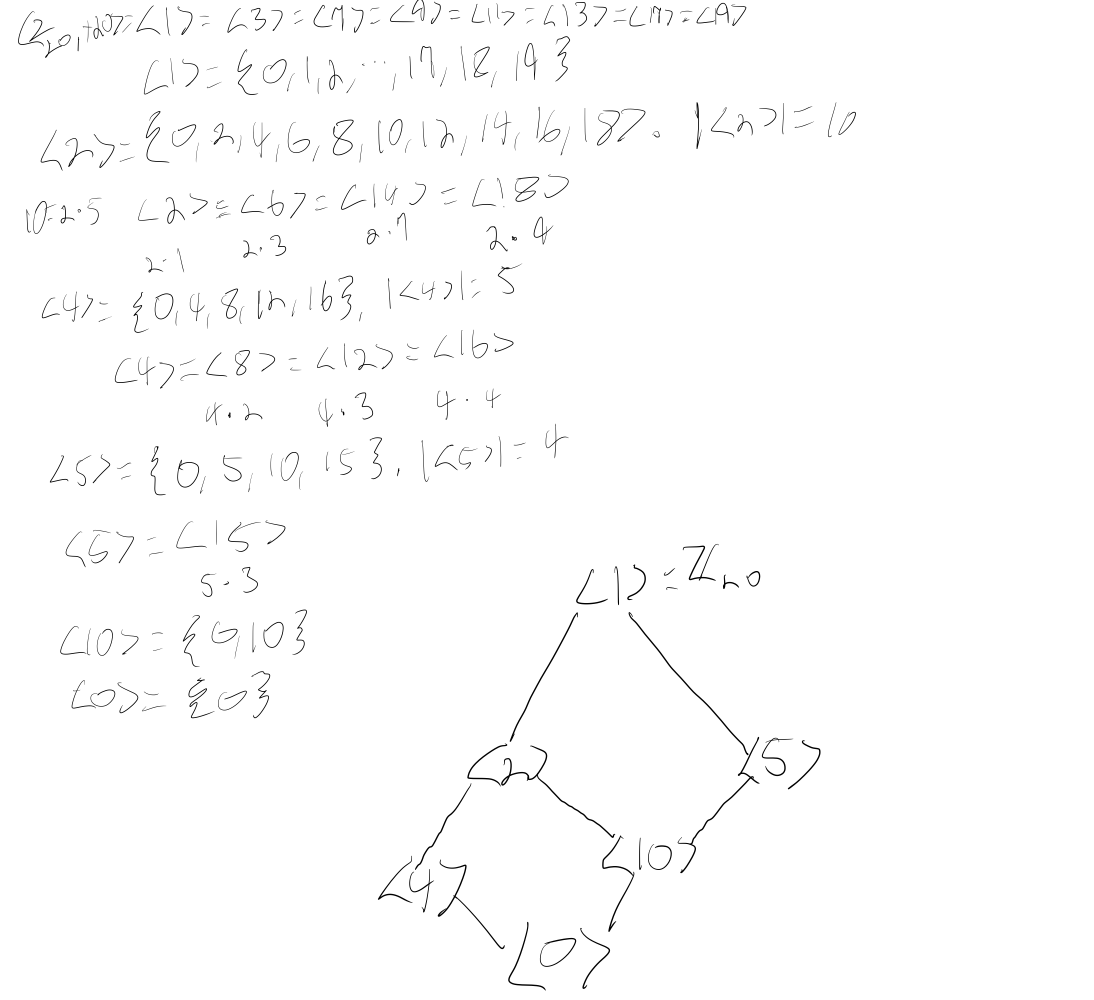
Let be a cyclic group with elements. Let and . Then generates a cyclic subgroup of containing elements, where . Two cyclic subgroups and are equal if and only if .
Suppose with and let . Then, .
So, .
Every element of a cyclic finite group will generate a cyclic subgroup. Some of these subgroups will be equivalent to others - we denote each subgroup , where is the smallest natural number that generates the subgroup.
To find the subgroups of a cyclic group, we follow this algorithm, keeping track of which elements we've found the generated subgroup for.
- Some element will generate the entire group. If the group's order is , then any element of the form where and are relatively prime will also generate the entire group, so note that we've found the generated subgroup for all of those elements.
- Starting with the next not covered already, find the subgroup generated by it - all elements of of the form . Note the order of this subgroup and call it . Any elements of of the form where is relatively prime with will generate the same subgroup. Note that we've found the generated subgroup for all of those elements.
- Repeat step 2 until we've found the subgroup generated by all elements.
Permutations
If we rearrange the ordered set to another order, say , then we get a permutation of .
This rearrangement is a bijection from to that performs
We can represent this permutation compactly using a matrix
Here, the top row is the input and the bottom row is the output, column-wise.
A permutation is a bijection , that is, a bijection from a set onto itself.
Referenced by (9 direct, 1 transitive)
Direct references:
Transitive (depth 1):
Generally, we talk about permutations on finite sets, but this doesn't seem to be a hard and fast rule.
The set of all permutations on the set is denoted by :
When is the finite set the group of all permutations of is the symmetric group on letters, and is denoted by . It has elements.
Permutations can be "multiplied", which is just composition. So if we have two permutations on , called and , means their multiplication, and we apply from right to left, so applies first and then . The result will also be a permutation in .
Referenced by (2 direct)
Direct references:
Permutation multiplication of permutations of a set forms a group:
Let be a nonempty set, and be the collection of all permutations of . Then is a group under permutation multiplication.
Orbits
Let be a permutation of , the orbit of containing is the set
So, are in the same orbit of , written as , if and only if for some .
The relation "~" is an equivalence relation (reflexive, symmetric, transitive). This means can be partitioned into orbits of .
Let be a permutation of . The equivalence classes in determined by the equivalence relation "~" are the orbits of .
Referenced by (1 direct, 2 transitive)
Direct references:
Transitive (depth 1):
Consider in . The orbit of
- containing 1 is because , , and .
- containing 2 is .
- containing 4 is .
So the orbits of are .
Cycles
A permutation is a cycle if it has at most one orbit containing more than one element. The length of a cycle is the number of elements in its largest orbit.
Referenced by (2 direct)
Direct references:
A cycle in may be written as - this is called cyclic notation. It represents the permutation that sends .
Two or more cycles are disjoint if no element appears in more than one cycle.
Every permutation of a finite set is a product of disjoint cycles.
Even and Odd Permutations
A cycle of length 2 is a transposition.
A permutation of a finite set is even if it is the product of an even number of transpositions.
A permutation of a finite set is odd if it is the product of an odd number of transpositions.
A permutation in can be written as either a product of an odd number of transpositions or a product of an even number of transpositions, but not both.
The subgroup of consisting of all even permutations of letters is the alternating group on letters. If , then this set forms a subgroup of of order .
Cosets
Let be a subgroup of . Given , the subset of is the left coset of containing , while the subset is the right coset of containing .
Referenced by (1 direct)
Direct references:
Referenced by (1 direct)
Direct references:
From the example above, the index of in is since there are 3 left cosets.
Layered Cosets
Here's a proof from a homework exercise I did.
Suppose and are subgroups of a group such that and suppose that and are both finite. Then is finite.
The intuition here is that each coset of can be partitioned into cosets of , and that can be partitioned into cosets of , so can be partitioned into cosets of . Since both and are given as finite, their product is also finite.
In more detail, say can be partitioned into cosets of , where is a natural number. Let be a set of coset representatives such that is a partition of formed by the left cosets of .
Then, is
and each is a disjoint coset of in .
Now, can be partitioned into cosets of , where is a natural number. Let be a set of coset representatives such that is a partition of formed by the left cosets of .
Then, . Now, we can recover by taking the union of the elements of , that is, , so the elements of , after a round of flattening, are the same as those of If we replace in (a) with , distribute each group action over the elements of , and then take the union across each resulting set we end up with
which is partitioned into the left cosets of . Because we constructed each element in by partitioning the elements of a partition of into cosets of (then taking their union), we know they are disjoint and cover all of . There are elements in , and since and are finite, so is .
Homomorphisms
A homomorphism is a map between groups (not necessarily a bijection), and that satisfies the homomorphism property:
Referenced by (2 direct, 1 transitive)
Direct references:
Transitive (depth 1):
Homomorphisms have some nice properties.
Suppose that is a group homomorphism. Then the following properties hold.
- If is the identity of , then is the identity in .
- If , then .
- If is a subgroup of , then the image of in is a subgroup of .
- If is a subgroup of , then the inverse image, is a subgroup of .
The kernel of a homomorphism is the set of elements that sends to , and it is denoted by . It is a normal subgroup of .
Referenced by (1 direct)
Direct references:
One useful fact you may recall from linear algebra that also applies with group homomorphisms is that is injective iff the kernel of is .
Simple Groups
A group is simple if it has no proper nontrivial normal subgroups, that is, if and the only normal subgroups of are and itself.
Referenced by (3 direct)
Direct references:
Every group has two important normal subgroups, the center and the commutator subgroup.
The center of a group is all the elements that commute with all elements of :