Arc Length and Line Integrals
Lengths of Parametric Curves
A function with a continuous first derivative is said to be smooth.
For a parametrically defined function where , both and must be continuous.
Referenced by (22 direct, 9 transitive)
Direct references:
- arc-length-in-plane
- Line Integral
- line-integral-over-a-plane-curve
- all-parameterizations-of-curve-have-same-line-integral
- Path Independent
- closed-path-of-path-independent-integral-is-zero
- Tangent Space
- Green's Theorem
- Surface Integral over Vector Field
- Divergence Theorem of Gauss
- Stoke's Theorem
- Contour Integral
- Indepenence of Path of Contour Integrals
- Cauchy Integral Theorem
- Cauchy-Goursat Theorem
- theorem-6
- theorem-7
- Cauchy Integral Formula
- First-order system
- Weakly Nonlinear Oscillator
- Machine Learning Basics
- Interpolation and Polynomial Approximation
If we think of a curve in a plane, we can think of the arc length differential as the "hypotenuse" of small triangles whose sides are and .
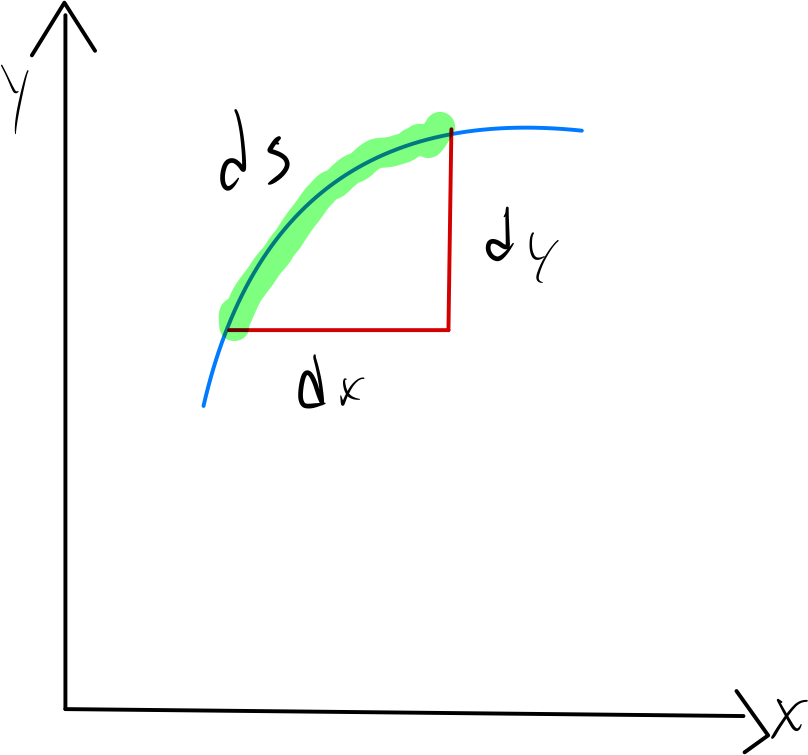
This makes
and the differential formula for arc length is then:
If a smooth curve , is traversed exactly once as increases from to , the curve's length is
The arc length of curve in can be defined the same way, assuming :
Note that the arc length formula for both 2 and 3 dimensions can be written using vector notation in the more compact form:
Line Integrals
A line integral is similar to integrating over an interval , except it allows us to integrate over a curve (curve integral would be a better name.)
If is defined on a smooth curve C given by , and if defined on , then the line integral of along is defined as:
Referenced by (11 direct, 1 transitive)
Direct references:
Transitive (depth 1):
If is a continuous function of two variables whose domain includes the smooth curve , then the line integral can be evaluated as:
Line integrals in the -plane that correspond to integrals in the complex plane take the form
When and are continuous and is smooth, we can calculate the value of the line integral by expressing and in terms of any parametric representation of and evaluating the resulting definite integral:
All parameterizations of the curve lead to the same value.
For some integrals, it does not matter what path is taken between two points; the value is always the same. Such line integrals are said to be independent of path.
We say that line integral 4.7 is independent of path in a domain if for any two points and in , the value of the line integral is the same for all piecewise smooth curves in from to .
Referenced by (1 direct)
Direct references:
There are two ways to ensure that a line integral is independent of path in a domain :
- Show that is the gradient of some function at every point of .
- If is simply-connected (every closed curve in contains in its interior only points of ), show that .
When a line integral is known to be independent of path, and its value is required along some curve with initial point and final point , we can either replace the given curve with a simpler curve, or, take the difference in the values of the function at and .
If a line integral is independent of path in a domain , and is a closed, piecewise smooth curve in that contains only points of in its interior, its value is zero: