Laurent Series
First, some background on geometric series.
The geometric series
can be written as
and converges for .
Now, when we have a term like we can write
and we can write
The geometric series from (a) will converge when , and the geometric series from (b) will converge when . So, we have a choice of which geometric series to take, depending on the region of we want to work in.
Laurent Expansion Theorem. Let be analytic in an annulus . Then can be expressed in the form
which converges and represents in .
Note the negative powers of - this is a distinguishing factor between Laurent series, which only apply to Complex functions and not Real functions, and Taylor series.
Example
We will find the Laurent series for for .
We can factor the denominator of to get
This makes it evident that has singularities at , and our domain of definition is an annular disc centered at , with an internal disc of radius and an annulus of width outside of that:
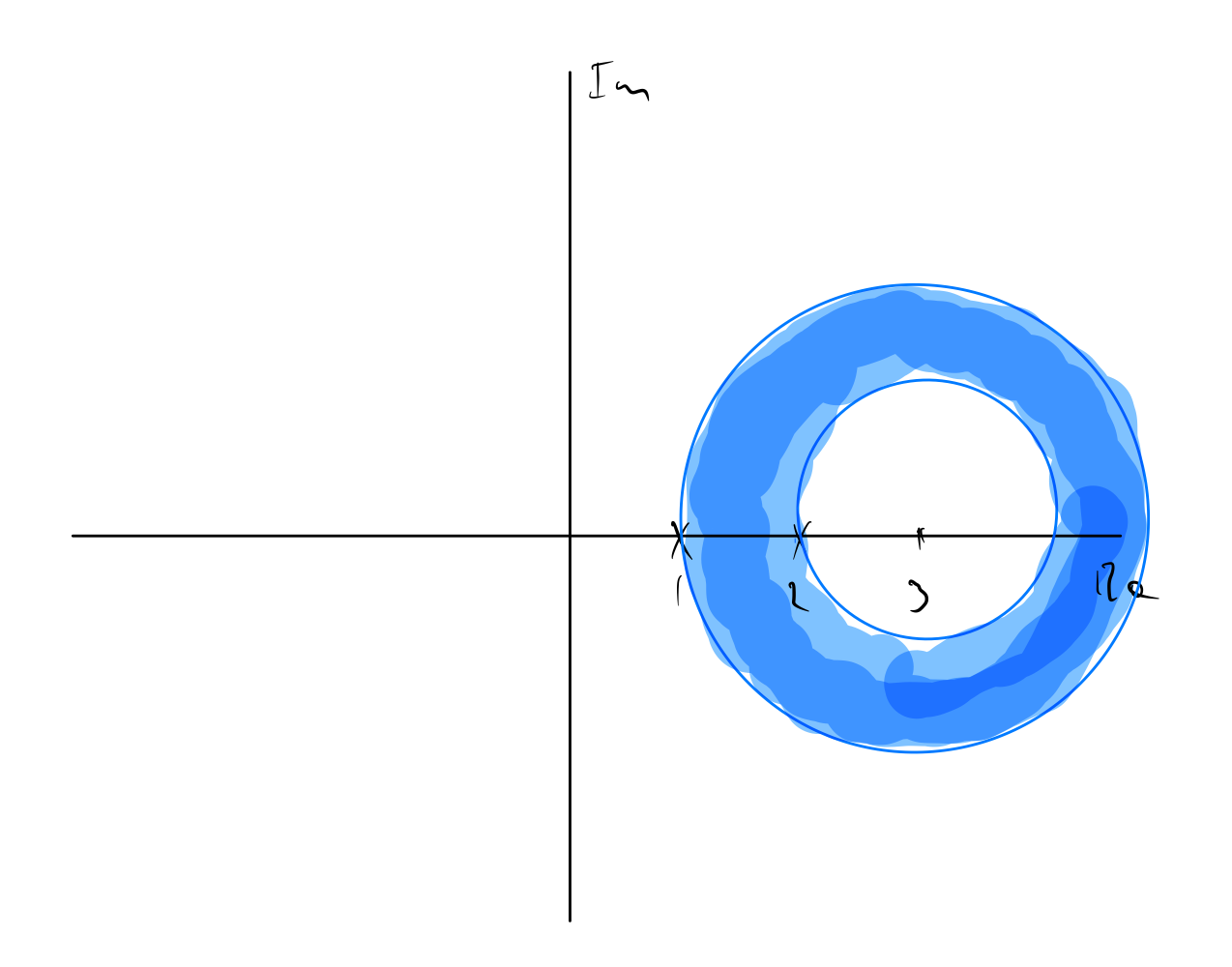
Now, via partial fraction decomposition we get
We need to use the two terms above to find geometric series in that converge for the interior of the annular disc, the region , and the exterior of the annular disc, the region .
Starting with the first term, we have
which converges for , which includes the region . Note that this series involves negative integer powers of as the term is in the denominator.
With the second term, we have
which converges for , which includes the region Note that this series involves positive integer powers of .
Combining the two, and adjusting the range of summation for the first series to get a term rather than , we can add the two together to get
General Method for Finding all Taylor and Laurent Series
If we want to find all of the Taylor and Laurent Series for centered at we can do this:
1. Consider where there are singularities.
If the is a disc around the center that contains no singularities, then we'll have a taylor series centered at that disc, and its region of convergence will extend until the first singularity is encountered.
If there is an isolated singularity at the center, then we'll only have Laurent series.
If there is an isolated singularity other than at the origin, then we may have a Taylor (or Laurent) series that's convergent around the origin, and then another Laurent series on the outside of that singularity.
It helps to draw these singularities and regions out - we need to find series to cover all of them.
2. Make a substitution to land
We let This translates us to being centered at which makes it easier to do algebraic manipulation.
3. Deal with each region
We write a series for each region by writing it as a binomial series, potentially multiplied by analytic factors.
For a Binomial Series, we have
So, we need to do something to make small. As an example, if we have
We can factor out from the denominator to get
where when so this is good for a disc around
On the other hand, we can factor out from the denominator to get
where when so this is good for an annulus where
4. Translate back to land
We substituted earlier, so we need to substitute that back into our series and then we're done. We have to be sure to keep track of which series converges for which region.