Algebraic Properties
Complex Numbers - Basics
A pure imaginary number is the product of a real number and a number which is defined by the relation .
A complex number is one which can be written in the form , where and are real numbers. The set of all complex numbers is denoted .
Referenced by (17 direct)
Direct references:
- Generalized Binomial Coefficient
- Examples of Rings
- Examples of Fields
- Algebraic Properties
- Regions of the Complex Plane
- Complex Functions
- Elementary Functions
- Finite Geometric Series
- Real Numbers
- Linear Independence of Functions. The Linear Differential Equation of Order n.
- Weakly Nonlinear Oscillators
- Discrete Fourier Transform
- is an inner product space
- proof-of-complex-inner-product-space
- remark-5
- Fourier Basis
- proof-of-fourier-basis
Note that the complex numbers include both the real numbers and the imaginary numbers.
The in the complex number is called the real part of z; the is called the imaginary part of z.
Note that the imaginary part of a complex number is itself real.
If , then the conjugate of z, written as , is .
To form the conjugate of a complex number, simply change the sign of the coefficient of .
If , then the absolute value of z or modulus of z, written as , is .
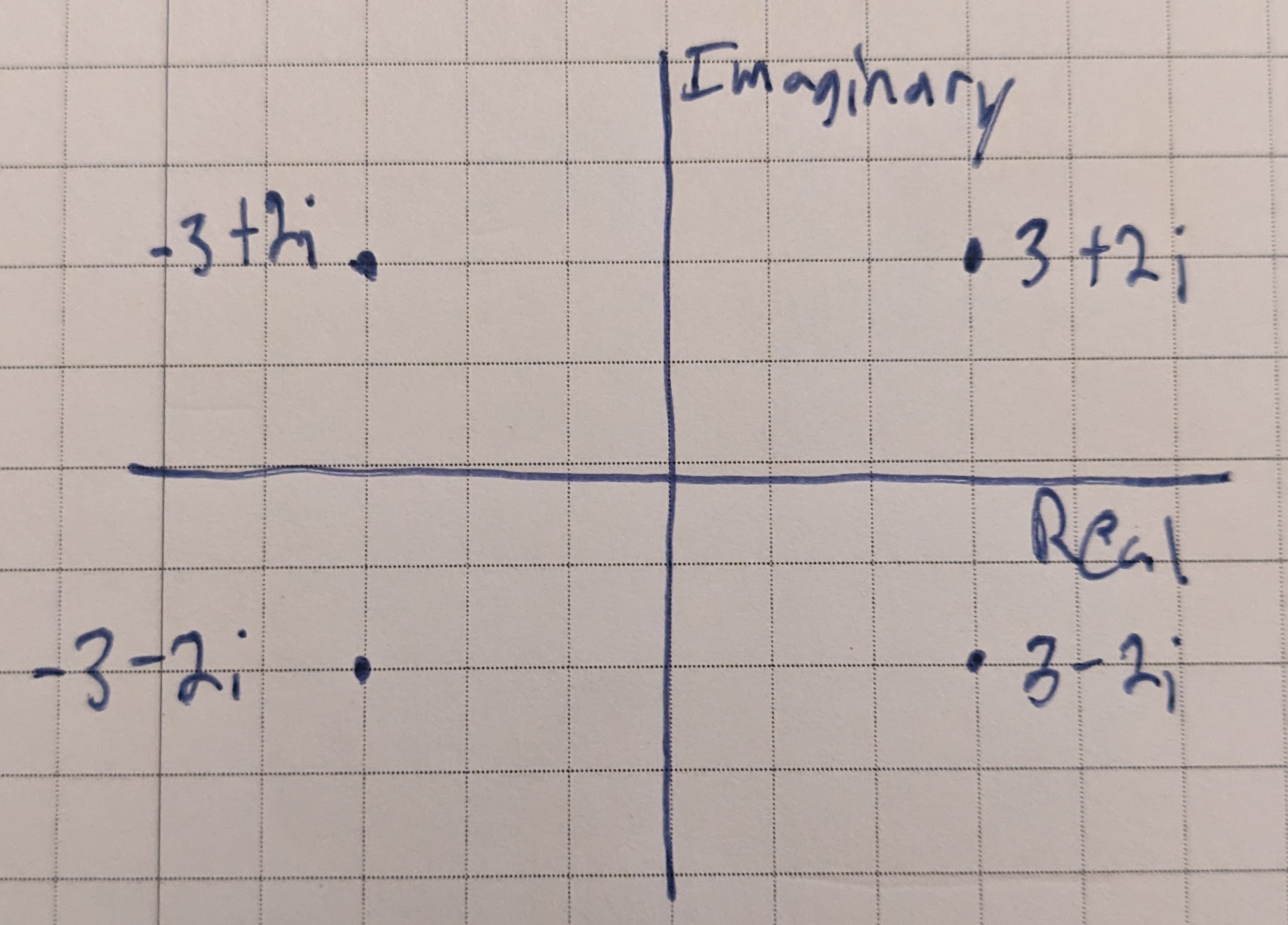
In a rectangular coordinate system, we can label the -axis as the real axis and the -axis as the imaginary axis, allowing us to represent any complex number graphically by plotting along the real () axis and along the imaginary () axis:
This also helps establish relationships between a complex numbe rand the polar coordinates of its point. In the following figure, we have represented graphically the complex number and the polar coordinate of its point:
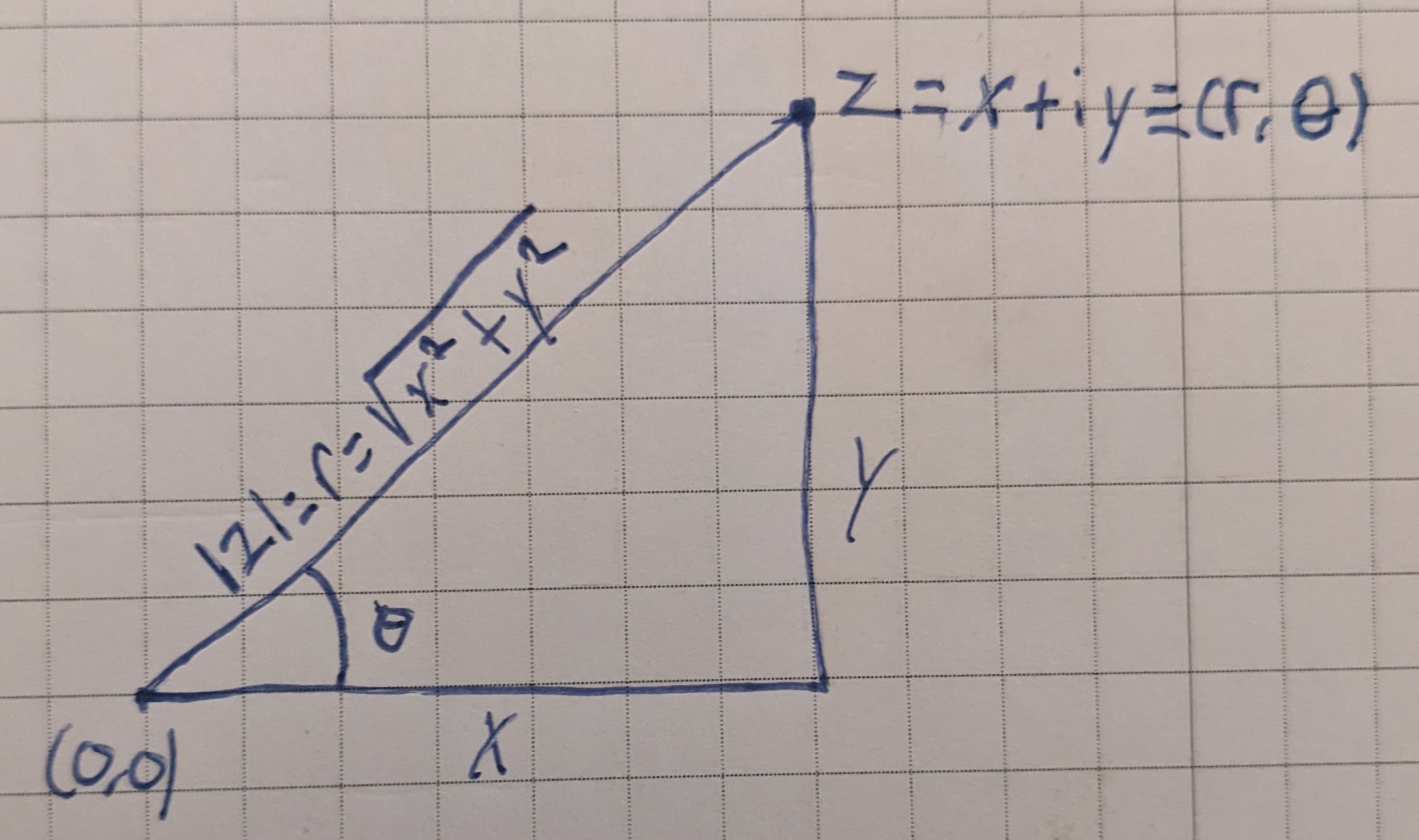
This image makes the following relationships obvious:
If we take
and call it the rectangular form of z, we can replace and with their polar equivalents to get:
which is called the polar form of z.
The polar angle in the figure above is called the principal argument of z, written as , and is defined to be an angle in satisfying the two equalities:
or
as long as is non-zero.
We can use to find the principal argument; if is in the first or fourth quadrants, it gives it directly. If is in the second quadrant, we must add to , and if is in the third quadrant we must subtract from .
Writing it as means that instead of taking the principal value of , we have a multivalued function giving all possible angles satisfying those two equalities:
Sometimes, is taken to mean any argument of so that it's still single valued.
When , no argument exists.
When and , the complex number lies on the imaginary axis and is either or .
We can also write a complex number in exponential form, by taking advantage of Euler's formula:
This means we can write a complex number with as
This form makes it super obvious that arguments add and moduli multiply when multiplying complex numbers:
Algebra of Complex Numbers
Here are the rules for performing addition, subtraction, multiplication and division with complex numbers. They follow the normal rules of algebra, with the number being replaced by its agreed upon value . If and are two complex numbers, then by definition:
We get some nice behavior when multiplying complex numbers in polar form due to the following property:
That is, when we multiply numbers complex numbers, we can add their arguments (and multiply their moduli):
This can be interpreted geometrically that multiplying by a complex number causes rotation in the complex plane.
Note that when we take the conjugate of a number we get This is a number with the same magnitude as but with the opposite angle. On the unit circle, where all numbers have the same magnitude, we have because multiplying by its conjugate rotates it exactly how much it was rotated, but in the opposite direction.
We can use this property to easily compute powers of complex numbers, which is sometimes called DeMoivre's theorem:
For complex and integer with we have
Square Root of Complex Numbers
To find the square roots of a complex number is to solve the following equation for :
If and are the real and imaginary parts of and we let and be the real and imaginary parts of , then we have:
from which we can form two equations by equating real and imaginary parts from both sides:
Now we have two equations and two unknowns, and when they are solved, we will have the two square roots of .
By definition, the principal square root of is the square root with the non-negative real part.
Complex Quadratics
We can use the quadratic formula to solve quadratics in a complex variable with complex coefficients, that is where
where and are complex; it may require taking the square root of a complex number.
Exponential, Trigonometric and Hyperbolic Functions of Complex Numbers
Some Maclaurin series expansions for a complex valued :
Interestingly, turns out to be a real number:
Using the series expansions above, we can prove the following identities which we will use in this chapter (see the book for proof outlines, full proofs are beyond the scope of the book):
The hyperbolic functions are defined as:
and are called, respectively, the hyperbolic sine, hyperbolic cosine, and hyperbolic tangent of .
Proof that imaginary roots of polynomials with real coefficients occur in pairs
(jmh my notes, the answers to exercises 18.6 through 18.9.)
First a couple of facts about adding and multiplying conjugates. Assume and .
Then:
and
Now the main proof follows. Given that is a root of
i.e. that the following statement is true:
and that , , ..., are real numbers, we will show that is also a root of (a), that is, that:
Going back to (b) we can take the conjugate of both sides to get:
Using (z.1), we can rewrite (d) as:
Using (z.2), we can rewrite (e) as:
Again using (z.2) and the fact that repeated times, we can rewrite (f) as:
Note that since are real numbers, they are complex numbers of the form , and since we have:
And therefore we can rewrite (g) as:
Which is the statement we wished to prove (c).