Limits of a Function
Delta Epsilon Definition of a Function on an Interval
Let be an open interval containing , and let be a function defined on , except possibly at . The limit of as approaches is , donoted as
means that given any , there exists such that for all , if , then
This means that when we pick any value of first to make a range of values around , that is, , if we can always find a value of around such that when , , then the limit as approaches is .
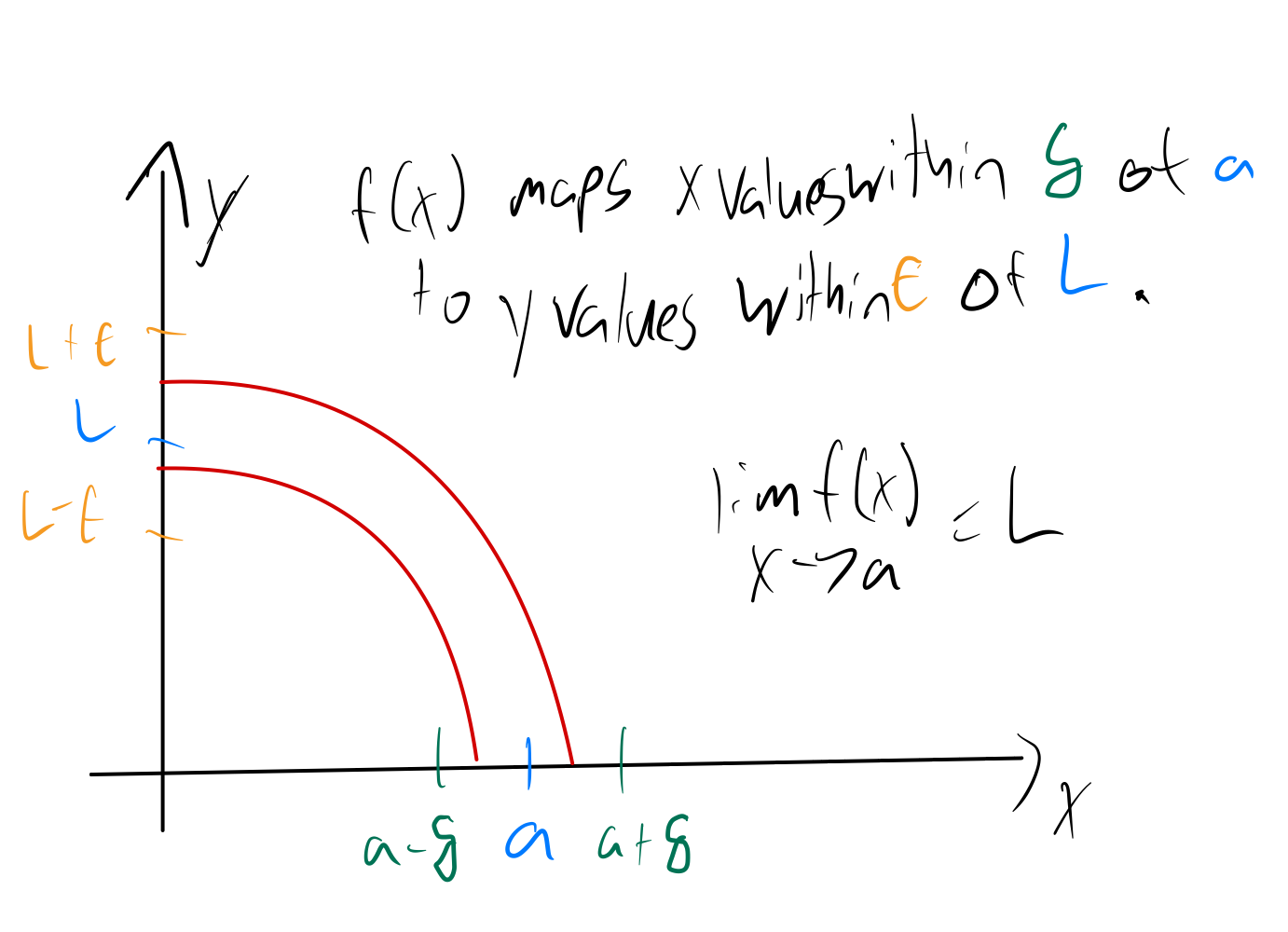
Example
Prove
We need to show that given , there exists such that
Basically, we need to find as a function of here to show that no matter what the value of is, we can find a satisfactory .
We can do this with some algebraic manipulation:
Now we've shown that as long as , then .
Limits of a Function on a Set of Real Numbers
This is more general than the definition above in that it applies to the case where there domain is a set of real numbers, not just an interval.
Let be a set of real numbers and be a function The limit of as approaches is written
if for every there exists some such that if We assume is a real number and that there are numbers satisfying
Limits of Function Rules
Suppose and Then
(same assumption as given above applies for the domains of containing values near
One-Sided Limits
Let be a set of real numbers containing and be a function The limit of as approaches from the right is written
if for every there exists a such that if We assume there are numbers satisfying
Let be a set of real numbers containing and be a function The limit of as approaches from the left is written
if for every there exists a such that if We assume there are numbers satisfying
Theorem: Let be a set of real numbers containing and be and assume that for every there are numbers satisfying Then if and only if
Limits Involving Infinity
Let be a set of real numbers and a function from into We say that the limit of as approaches infinity is written as
if for every there exists a real number such that if
Let be a set of real numbers and a function from into We say that the limit of as approaches negative infinity is written as
if for every there exists a real number such that if
Tricks
Factoring a root out of a numerator
Say we have:
Since is going to infinity it is positive and for positive , we can factor out a root to simplify:
From there we can move the limit inside the radical: