Contour Integrals
A contour integral is essentially a line integral in the complex plane.
Given a smooth curve in a domain and a continuous function defined along , we say that
We can parameterize as
Then,
and by the chain rule,
Therefore,
or equivalently
Then we have
Referenced by (5 direct)
One trick we can use is that when the modulus of a function is constant, we can use the argument of as a parameter by writing
When the path of integration in a contour integral is a closed curve, we place a circle on the integral sign
You can add an arrow to the circle to indicate clockwise vs counterclockwise direction, but that's not supported in MathJax so I don't have it here!
Some additional properties:
where is the maximum value of for on , and is the length of .
Here's an example problem: evaluate where is the closed (triangular) path from to () to () back to ():
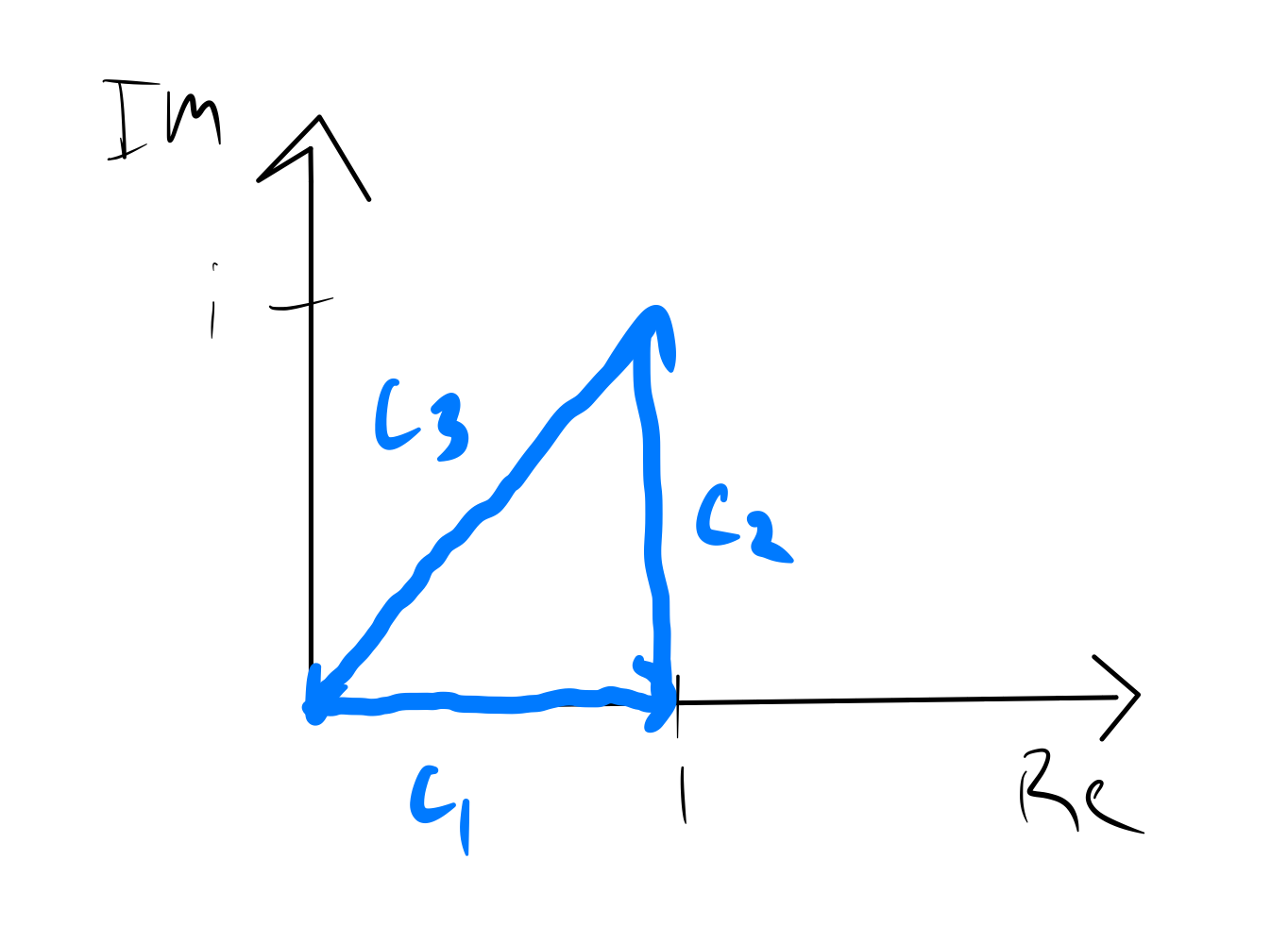
where
Thus,
Some Important Contour Integrals
First, we'll compute where is the unit circle. We'll call this out as a theorem, because it's a super important result that gets used all the time in complex analysis.
If is the unit circle, then
First, note that we can parameterize the unit circle, as
Now, making the substitution,
Now, using the definition of the contour integral,
we have, noting that