Limits of Complex Functions
See first the Limits notes for two dimensional functions.
Delta Epsilon Definition
Let be an open set containing , and let be a function defined on , except possibly at . The limit of as approaches is , donoted as
means that given any , there exists such that for all , if , then
This means that when we pick any value of first to make an open disc of values around , that is, , if we can always find a value of such that when , , then the limit of as approaches is .
This is similar to limits of two dimension functions, except that instead of having open intervals on the and axis, respectively, around and , we have open discs in the and planes, respectively, around and .
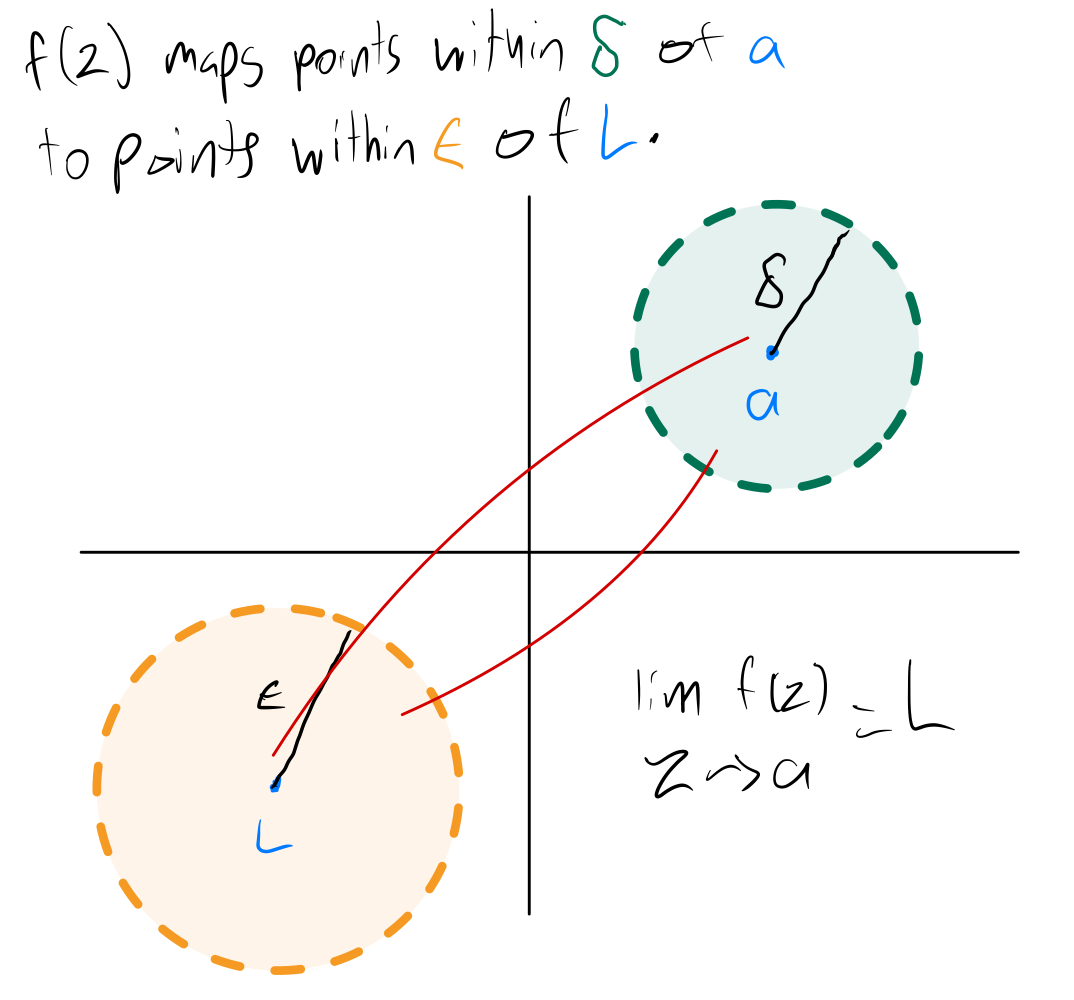
Whereas for limits on the 2d plane to exist, we need to get the same limit approaching from the left or right of , for limits on the complex plane to exist, we need to get the same limit approaching from any direction.
Continuity
A complex function is said to be continuous at if
The function is said to be continuous on an open set if it is continuous at each point in the set. This definition imposes three conditions of the function :
- must be defined at ;
- the limit of as must exist;
- the numbers in 1. and 2. must be identical.
Continuous functions can be added, subtracted, multiplied, and divided, and their results will still be continuous.
A discontinuity in a function at is said to be a removable discontinuity if we can assign a value to the function at that makes the function continuous.
Branches, Branch Points and Branch Cuts
A multi-valued function such as can be made single valued by restricting its range. For example, if we restrict the range of to be , then it is single valued. restricted in this manner will be discontinuous at and along the positive real axis.
We could similarly restrict the range to any other interval and call this fuction and it will be discontinuous at and along the half-line that forms the angle with the positive real axis.
This restricted range version of is said to be a branch of . The half-line along which it is discontinuous is called the branch cut of the branch, and the point at which all branch cuts meet is called the branch point of the multi-valued function .