Polar Coordinates
This isn't strictly a calculus topic but it comes up a lot with calculus so I'm sticking it here. I'm not really sure what "part" of math coordinate systems belong to; they are used all over the place and have geometric and algebraic interpretations.
Definition
Polar coordinates are a 2d orthogonal coordinate system where coordinates are given by two components, radius and angle, i.e.
The radius is the distance from the origin to and the angle is the angle formed with a line measured counter-clockwise from the positive -axis to a line passing through .

Converting Between Rectangular and Polar
Derivatives
If we parameterize such that and and want to find and in polar coordinates, we have:
thus:
Doing some tedious algebra from here, we can arrive at definitions of and in terms of , but it's easier if we start with the following, letting :
Differentiating the first equation in (c) with respect to we get:
Rewriting the second equaton in (c) and then differentiating with respect to we get:
Summarizing (d) and (e) we have:
Therefore, the derivative of with respect to is:
Radial and Transverse Components of Motion
Given a particle at point moving in a plane, we can define the radial and transverse components of the particle's motion.
Radial: The particle's motion in the direction away from the origin, that is, in the direction that purely increases the coordinate of the particle's position.
Transverse: The particle's motion in the direction tangential to its radius, that is, in the direction that purely increases the coordinate of the particle's position.
Let's call the radial direction and the transverse direction . Also recognize that the radial and transverse directions are orthogonal - moving in the radial direction doesn't change the transverse component and vice versa.
Let's assume the particle at is moving in the direction of point , at velocity . We can then say that the velocity vector for the particle is given as the vector .
Then, the component of in the direction is the projection of onto , whose magnitude is given by , and the component of in the direction is the projection of onto , whose magnitude is given by . The following image shows this geometrically:
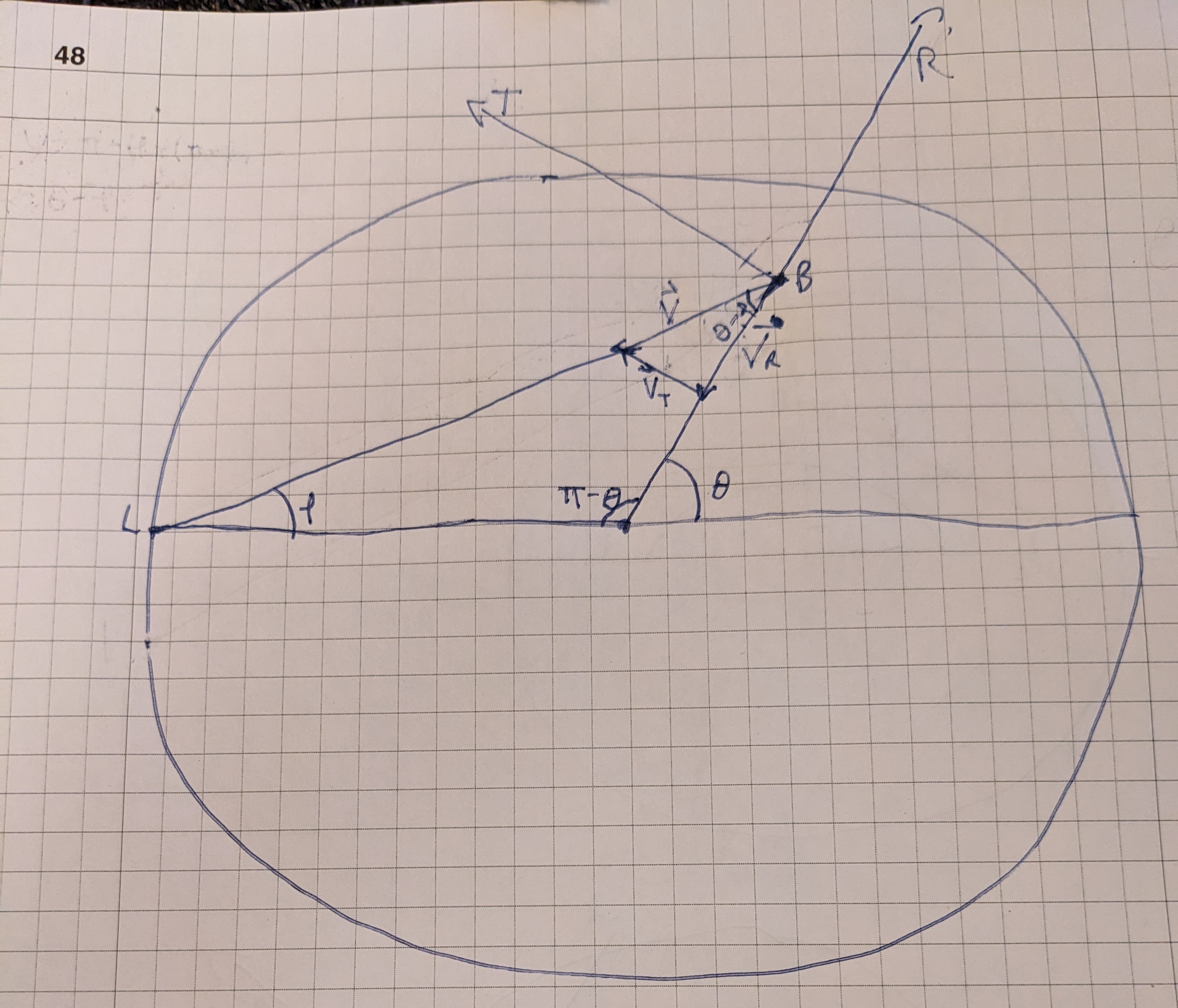
Here, you can see that we can sort of think of the direction as the -axis and the direction as the -axis when thinking about how to find the amount of motion in the and directions. It's important to remember, though, that for a moving particle, its position is changing constantly, and so are the and directions, so they don't make good fixed references.
We must also point out that is moving in the negative direction here and so is reducing the radius. In vector component form it would be given as and the derivative of the radius with respect to time would be given by .
Also, while , this doesn't tell us the change in with respect to time, it only tells us the amount of linear movement in the tangential direction. The change in angle also depends on the radius - the further from the origin we are, the less the angle will change. The derivative of the angle with respect to time is then given by . Note: The division by here needs better justification. It's intuitive that the bigger , the less the change in angle, but it's not clear why it should be a linear factor.
Other Notes
I found the notes in this document on converting a system of rectangular differential equations to polar coordinates particularly helpful.