Trajectories
Isogonal Trajectories
When two curves intersect in a plane, the angle between them is defined to be the angle made by their respective tangents drawn at their point of intersection.
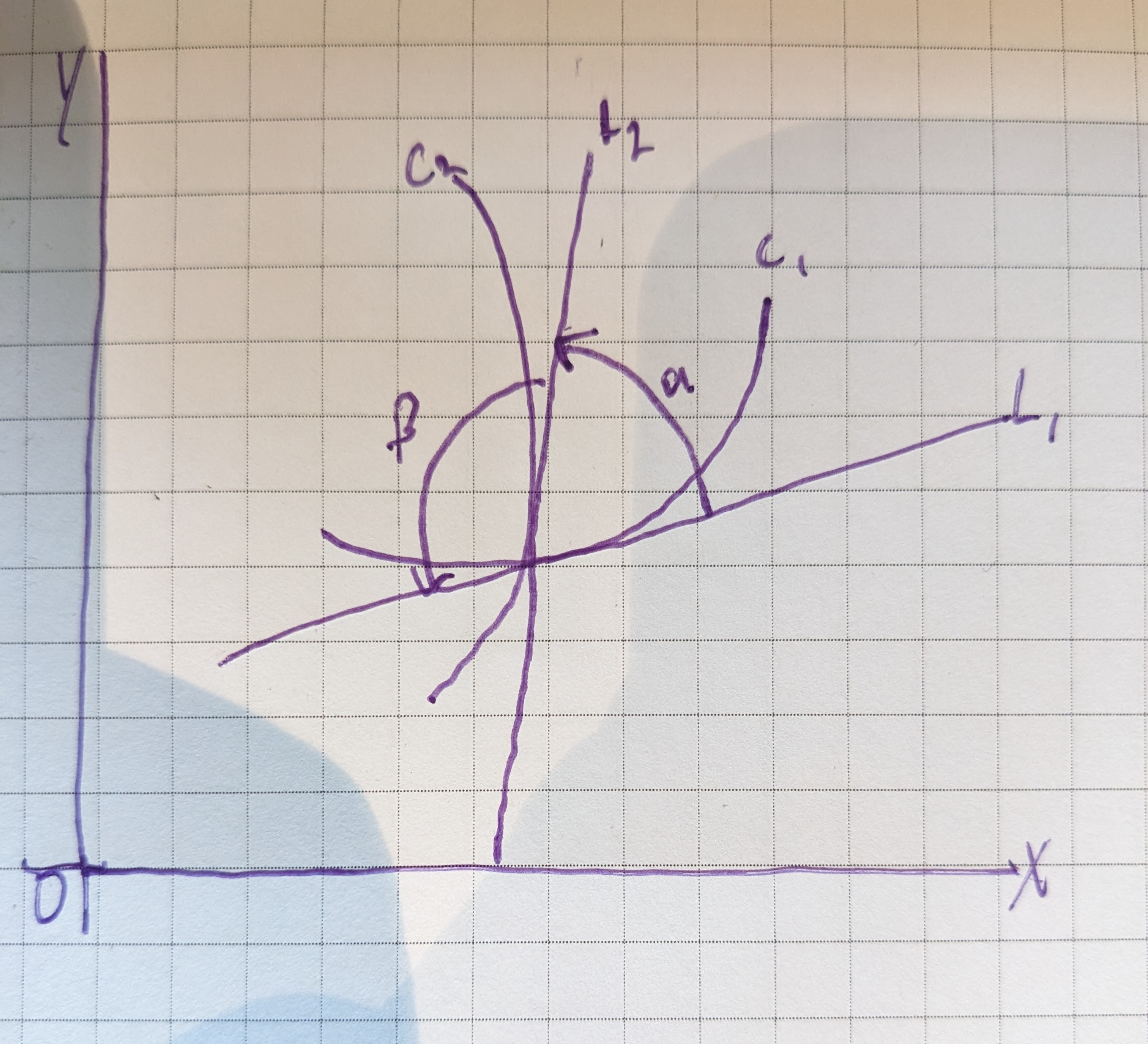
In the above figure, is the positive angle from the curve with tangent line to the curve with tangent line ; is the positive angle from the curve to the curve . If we call the slope of and the slope of , then by a formula in analytic geometry:
Definition 14.12 A curve which cuts every member of a given 1-parameter family of curves in the same angle is called an isogonal trajectory of the family.
If we call the slope of a curve of a given 1-parameter family, the slope of an isogonal trajectory of the family, and their angle of intersection measured from the tangent line with slope to the tangent line with slope , then by (14.11):
Orthogonal Trajectories
Definition 14.2 A curve which cuts every member of a given 1-parameter family of curves in a angle is called an orthogonal trajectory of the family.
Let be the slope of a give nfamily and let be the slope of an orthogonal family. Then, by a theorem in analytic geometry:
Orthogonal Trajectories in Polar Coordinates
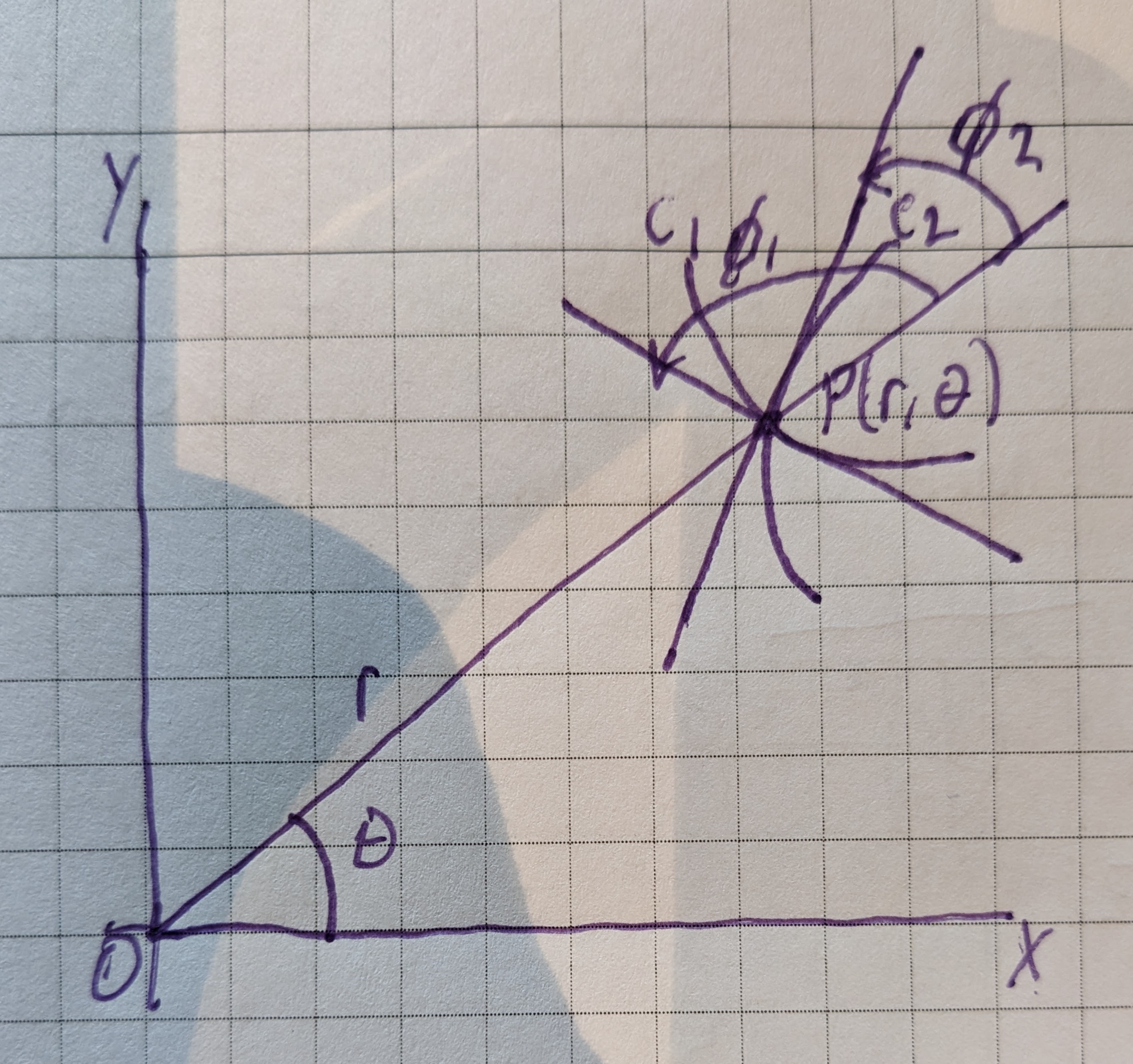
In the above figure, call the point of intersection in polar coordinates of two curves , which are orthogonal trajectories of each other. Call and the respective angle the tangent to each curve and makes with the radius vector (measured from the radius vector counterclockwise to the tangent). Since the two tangents are orthogonal, it is evient form the figure that:
Therefore
As remarked previously in Example 13.3, in polar coordinates:
Therefore (14.31) becomes:
Comparing (14.32) with (14.33) we see that if two curves are orthogonal, then of one is the negative reciprocal of of the other. Conversely, if one of two curves satisfies (14.32) and the other satisfies (14.33), then the curves are orthogonal.
Hence, to find an orthogonal family of a given family, we proceed as follows:
- Calculate of the given family.
- Replace by its negative reciprocal
- The family of solutions of this new resulting differential equation is orthogonal to the given family.