Regions of the Complex Plane
This overlaps with the definitions in Metric Spaces - I need to combine these!
An -neighborhood of a point is the set of all complex numbers satisfying
This is the set of all complex numbers interior to a circle of radius and center , but not including the circumference of the circle.
A point of a set of complex numbers is called an interior point of if there exists an -neighborhood of that contains only points of .
On the other hand, is a boundary point of if every -neighborhood of contains at least one point of and at least one point not in . The set of all boundary points of a set is called the boundary of .
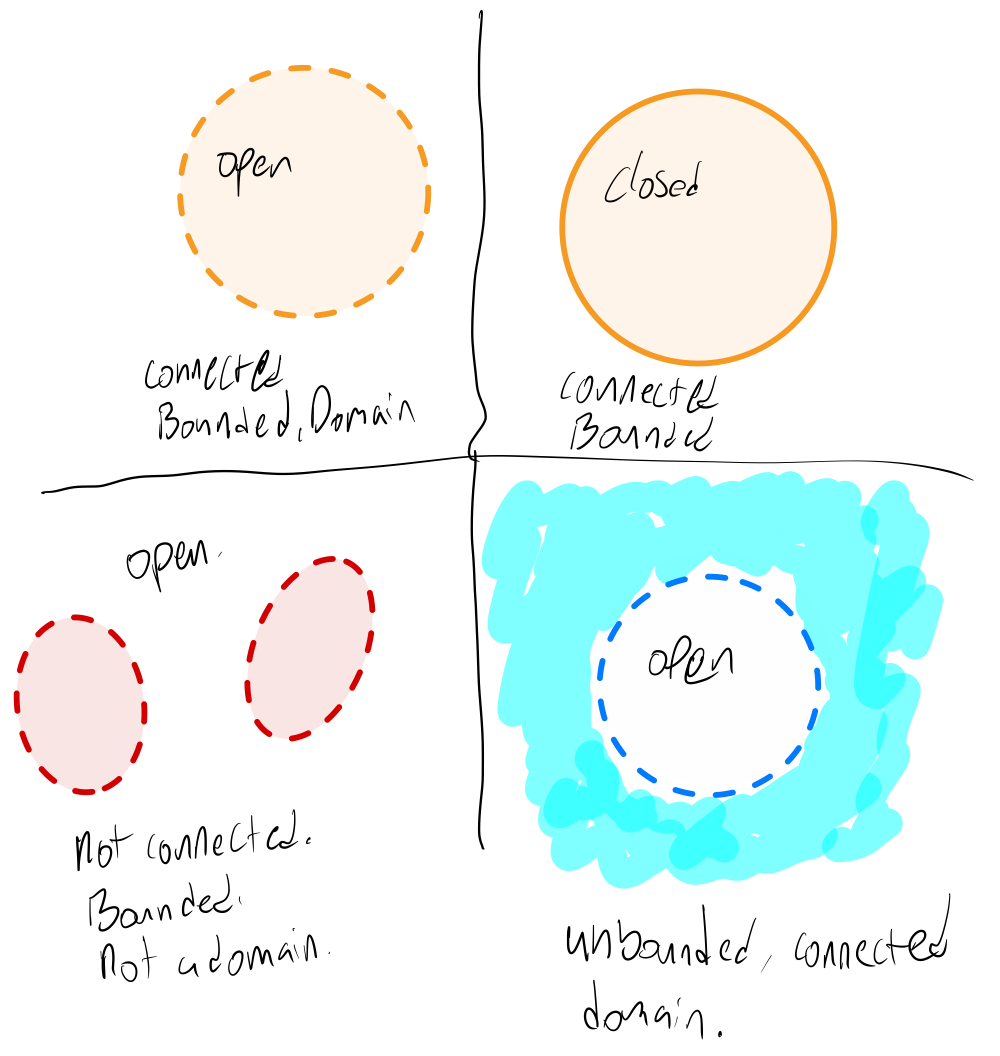
A set of complex numbers is said to be open if all points in are interior points. Alternatively, a set is open if it contains none of its boundary points.
A set of complex numbers is said to be closed if it contains all of its boundary points.
Note that a set can be both open and closed! Both the empty set and are both open and closed.
A set of complex numbers is said to be bounded if there exists a positive (real) number such that for all in . This means that a set is bounded if all its points fit within a circle of finite radius. A set that is not bounded is said to be unbounded.
A set is said to be connected if every pair of points in can be joined by a finite number of line segments joined end to end that lie entirely within .
Referenced by (1 direct)
Direct references:
- Connected Sets (embedded)
A domain is an open connected set. Note that this is not the same as a domain of definition of a function.
Referenced by (19 direct, 90 transitive)
Direct references:
- Path Independent
- remark-12
- closed-path-of-path-independent-integral-is-zero
- theorem-19
- Green's Theorem
- Volume Integral
- Divergence Theorem of Gauss
- Stoke's Theorem
- Derivatives of Complex Functions
- Harmonic Functions
- Elementary Functions
- Contour Integral
- Indepenence of Path of Contour Integrals
- Cauchy's Integral Theorem
- Cauchy Integral Theorem
- Taylor Expansion Theorem
- Residue Integration
- Separation of Variables
- Random Variable
Transitive (depth 1):
- proof-of-cauchys-integral-theorem
- proof-of-integral-of-one-over-z-around-unit-circle
- theorem-7-intuition
- A/B Test
- Absolutely Continuous Random Variable
- Binomial Distribution
- chebyshev-fish
- Chebyshev's Inequality
- chebyshevs-inequality-note
- Cumulative Distribution Function
- Discrete Random Variable
- Entropy
- Expected Value
- Jensen's Inequality
- markov-inequality-fish
- Markov's Inequality
- Moment Generating Function
- Negative Binomial Distribution
- Normal Approximation to the Binomial
- Normal Distribution
- Poisson Approximation to the Binomial
- Poisson Distribution
- Probability Distribution
- proof-of-chebyshevs-inequality
- remark-14
- Self-Information
- Standard Normal Distribution
- State Space
- theorem-16
- Uniform Distribution
- Uniform distribution maximizes entropy
- Variance
Transitive (depth 2):
- Hypergeometric Distribution
- proof-of-law-of-large-numbers
- Identically Distributed
- Independent and Identically Distributed
- Mutual Independence
- Pairwise Independence
- Geometric Distribution
- Cross-Entropy
- doubly-stochastic-maps-increase-entropy-intuition
- Entropy Rate
- Gibbs' Inequality
- Chain rule for joint entropy
- joint-entropy-is-less-than-or-equal-to-entropy-of-parts
- KL Divergence
- Noiseless channel transmitting discrete symbols
- note-25
- note-8
- proof-of-concavity-of-entropy
- proof-of-doubly-stochastic-maps-increase-entropy
- proof-of-joint-entropy-is-less-than-or-equal-to-entropy-of-parts
- proof-of-uniform-distribution-maximizes-entropy
- theorem-12
- Weak Asymptotic Equipartition Property
- Interpretation
- proof-of-markovs-inequality
- proof-of-weak-asymptotic-equipartition-property
- proof-of-gibbs-inequality
- proof-of-log-sum-inequality
- Moment Generating Function of a Sum
- Sum of Independent Normal Random Variables
- Sum of Independent Poisson Random Variables
- Conditional Probability Distribution
- Product Distribution
- note-15
- remark-8
- note-3
- concavity-of-entropy-intuition
- Confidence Interval for a Mean, Known Variance
- Confidence Interval for a Mean, Unknown Variance
- Standard Deviation
- variance-interpretation
Transitive (depth 3):
- proof-of-joint-is-marginal-times-conditional
- Model Training
- Strong Asymptotic Equipartition Property (Shannon--McMillan--Breiman)
- proof-of-nonnegativity-of-conditional-mutual-information
- proof-of-nonnegativity-of-conditional-relative-entropy
- proof-of-nonnegativity-of-mutual-information
- proof-of-nonnegativity-of-relative-entropy
- Law of Large Numbers
- proof-of-chain-rule-for-entropy
- proof-of-mutual-information-and-entropy
- proof-of-theorem-54
- remark-32
- Multiplication Rule for Distributions
- Mutual Information
- theorem-7
- Central Limit Theorem
Transitive (depth 4):
In the images below, a dashed line represents a boundary that is not included the in the set, while a solid line represents a boundary that is included in the set.
Squiggly blue highlighter indicates the set goes on forever and the party never ends!