Review
Periodic Functions: A function is periodic of period if for all in the domain of .
Even Functions: A function that satisfies for all in the domain of has a graph that is symmetric with respect to the -axis. We say such a function is even. The functions are examples of even functions, as is .
Odd Functions: A function that satisfies for all in the domain of has a graph that is symmetric with respect to the origin. It is said to be an odd function. The functions are examples of odd functions, as are and .
Knowing these properties can be useful when evaluating indefinite integrals.
If is an even piecewise continuous function on , then
if is an odd piecewise continuous function on , then
Some Important Integrals
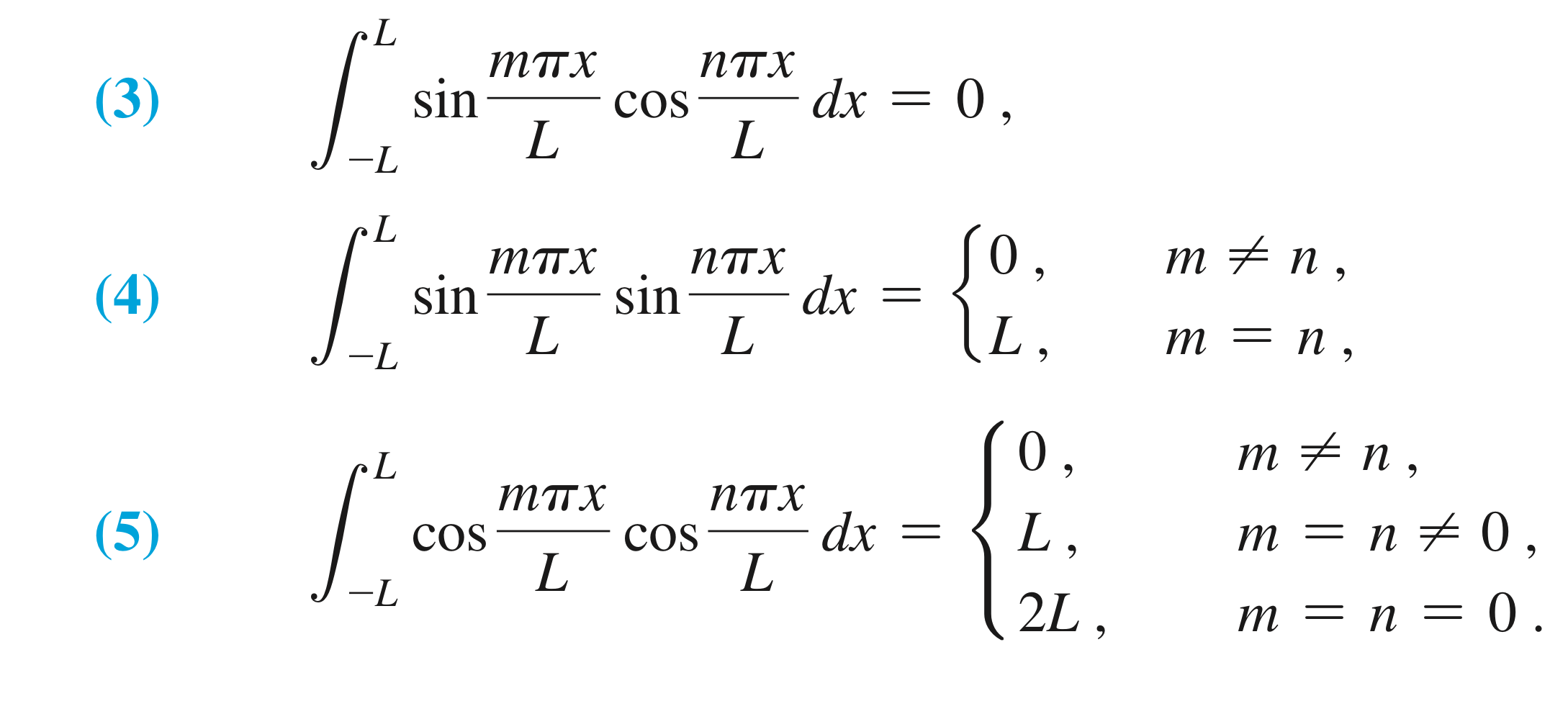
The following three integrals are crucial in Fourier series. In each, and are nonnegative integers.
The first integral:
We can simplify this using the trig identity for products of sines and cosines,
Since this is an integral from to over an odd function, it, and thus always equals 0.
The second integral:
This time we use the trig identity
Here, we have to consider two cases, and . If , ; also note that this integral is over an even function from to , so (b.1)
The final in (b.2) is always because for integer is always . So, when , (b) evaluates to .
When , we can't simplify either in the integrand and end up with two 's that are always 0, so when , (b) evaluates to .
The third integral:
This time we use the trig identity
Here, we need to consider 3 cases: ; ; . The first two cases work out just like (b), and when we get 0, when but and are non-zero we get .
However, when , both in the integrand end up as , and so the integral simplifies to:
Thus, when , (c) evaluates to 2L.
The following table (from "Differential Equations and Boundary Value Problems", Nagle, et al, 2017, p574) summarizes these integrals nicely:
Fourier Series
Definition: Let be a piecewise continuous function on the interval . The Fourier Series of is the trigonometric series
where the 's and 's are given by the formulas:
Formulas (9) and (10) are called the Euler-Fourier formulas. The symbols in (8) means that the series is associated with but may not converge to .
Example 1
Find the Fourier series for , .
Here, = . We get lucky here because is even, so all terms are 0 (if it were odd, all terms would be 0). First, we'll find using (8). Since is even, we simplify and integrate over just the positive half and double the result:
Now, we find using (8), again taking advantage of our integrand being even, and then using integration by parts:
Now, using (9) we can write our Fourier series:
The first few terms are:
Extensions
If we have a function that is defined on , and we recall that an odd function defined on has only sine terms, we might wish to construct an artificial extension of onto in such a way that the extended function is odd, so we could construct a Fourier series for the function that consists only of sine terms. We can accomplish this by defining the function
and extending to all using -periodicity (well, all other than integer multiples of ). Since is odd, its Fourier series will contain only sine terms, and since on is an extension of . Specifically, it's called the odd 2L-periodic extension of The resulting Fourier series expansion is called a half-range expansion for since it represents the function on which is half the interval where it represents
Similarly, we can define the even 2L-periodic extension of as
Its Fourier series would contain only cosines.
Fourier Cosine and Sine Series
Using the notions of expansions above, we have the following definitions.
Let be a piecewise continuous function on the interval The Fourer cosine series of on is
where
The Fourer sine series of on is
where
The series in (4) is the Fourier series for , and that in (6) is the series for . These are called half-range expansions for .